


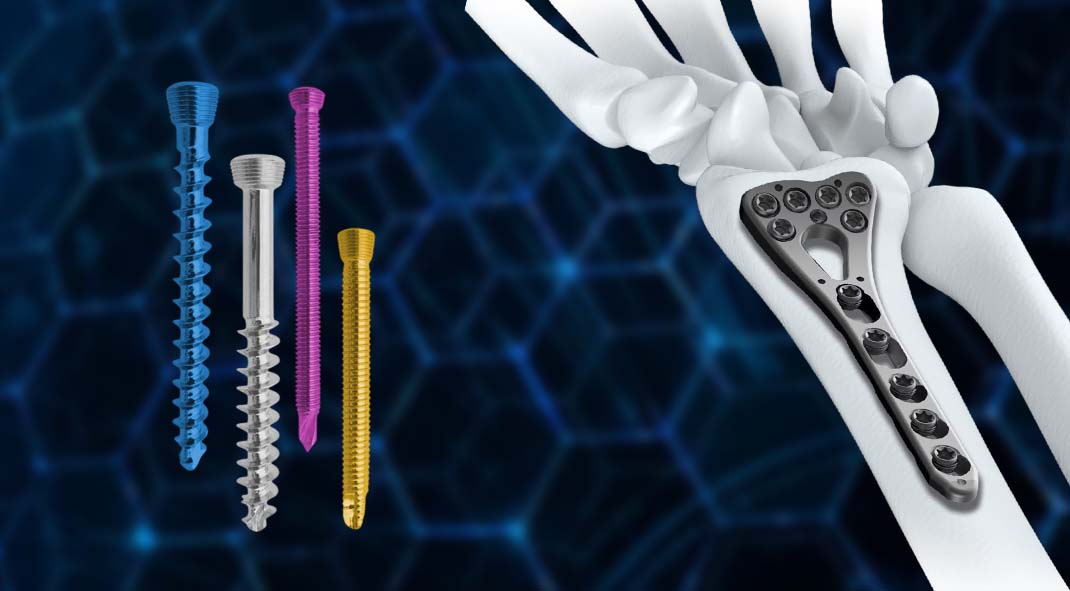
Locking screws are specialized screws used in locking compression plates (LCPs) and other orthopaedic implants to provide stable fixation in fracture management. Unlike conventional screws, which rely on friction between the plate and bone for stability, locking screws have threads that engage both the bone and the plate, creating a fixed-angle construct. This design offers several advantages:
Types of Locking Screws
Locking screws are designed to provide fixed-angle stability when used with locking plates. Different types exist based on thread design, head shape, material, and specialized functions. Below is a detailed classification:
Based on Thread Design
Fully Threaded Locking Screws
- Description: The entire shaft is threaded, providing uniform fixation along the length of the screw.
- Uses: Common in locking compression plates (LCPs) and periarticular fractures.
- Advantage: Ensures uniform load distribution and enhances pullout resistance.
Partially Threaded Locking Screws
- Description: The proximal (near the head) portion is smooth, while the distal portion is threaded.
- Uses: Used in fractures where only partial engagement is required (e.g., fractures near joints).
- Advantage: Allows compression at the fracture site while maintaining stability.
Based on Head Design
Monoaxial Locking Screws
- Description: The screw head locks into the plate at a fixed angle (predetermined by the plate design).
- Uses: Standard in most locking plate systems.
- Advantage: Strong, stable fixation but lacks flexibility in angulation.
Polyaxial Locking Screws
- Description: The screw head allows variable angles (usually ±15° to ±30°) before locking into the plate.
- Uses: Used in periarticular plates and cases requiring greater surgical flexibility.
- Advantage: Provides better screw trajectory control in complex fractures.
Based on Screw Tip Design
Self-Tapping Locking Screws
Description: Has a cutting flute at the tip, allowing the screw to cut its own path in the bone.
Uses: Commonly used in locking plate systems.
Advantage: Eliminates the need for pre-tapping, reducing surgical steps.
Self-Drilling and Self-Tapping Locking Screws
- Description: Contains both a drilling tip and a cutting flute, allowing direct insertion without pre-drilling.
- Uses: Used in minimally invasive surgery (e.g., external fixation).
- Advantage: Saves time, reduces surgical trauma, and is useful in emergency procedures.
Non-Self-Tapping Locking Screws
- Description: Requires a pre-tapped hole before insertion.
- Uses: Used in dense bone regions where precise thread engagement is needed.
- Advantage: Ensures optimal screw-bone contact in areas of high bone density.
Based on Material Composition
Stainless Steel Locking Screws
- Description: Made from medical-grade 316L stainless steel.
- Uses: Common in trauma surgery and general fracture fixation.
- Advantage: High strength, good biocompatibility, and cost-effective
Titanium Locking Screws
- Description: Made from titanium alloy (Ti-6Al-4V).
- Uses: Preferred in osteoporotic bone and biodegradable fixation.
- Advantage: Corrosion-resistant, lightweight, and has better biocompatibility than stainless steel.
Based on Special Functionality
Cannulated Locking Screws
- Description: Hollow core allowing placement over a guide wire.
- Uses: Used in minimally invasive procedures, such as proximal femoral fractures.
- Advantage: Allows precise placement with minimal surgical trauma.
Headless Locking Screws
- Description: No prominent screw head, making it flush with the bone surface.
- Uses: Used in intra-articular fractures (e.g., scaphoid, talus fractures).
- Advantage: Prevents soft tissue irritation and provides better compression.
Variable Angle Locking Screws
- Description: Allows surgeons to adjust the screw trajectory within a range (e.g., ±15° from the plate axis).
- Uses: Used in periarticular and reconstructive surgery.
- Advantage: Provides more flexibility in complex fracture fixation.
Resorbable Locking Screws
- Description: Made from biodegradable materials (e.g., polylactic acid or magnesium-based alloys).
- Uses: Used in pediatric fractures and sports injuries.
- Advantage: Eliminates the need for implant removal surgery.
Benefit of Locking Screws
Locking screws offer several significant advantages in orthopaedic fracture fixation, particularly when used with locking plates. Here’s a detailed breakdown of their benefits:
Fixed-Angle Stability
- Traditional screws rely on friction between the plate and the bone for stability. In contrast, locking screws engage directly with the plate, creating a fixed-angle construct.
- This prevents screw loosening and maintains stability even in osteoporotic or comminuted fractures, where bone purchase is poor.
Better Stability in Osteoporotic Bone
- In elderly patients with weak or brittle bones, conventional screws may strip out of the bone, leading to implant failure.
- Locking screws distribute the load over a larger area and do not rely on bone compression, making them ideal for osteoporotic fractures.
Reduces Dependence on Bone-Plate Contact
- Conventional screws require the plate to be pressed tightly against the bone for stability.
- Locking screws eliminate this requirement, meaning they work even when there are gaps between the bone and plate.
- This is useful in cases of periosteal damage, where excessive compression may compromise blood supply and delay healing.
Preserves Blood Supply & Promotes Healing
- Locking plates function as internal fixators rather than compression plates, minimizing contact with the periosteum.
- This preserves periosteal blood flow, promoting better healing and reducing the risk of bone necrosis.
Reduces Micromotion & Improves Load Distribution
- Because locking screws are fixed within the plate, there is minimal micromotion at the bone-implant interface.
- This reduces the risk of implant failure by evenly distributing mechanical loads across the screws.
Less Risk of Screw Backout or Loosening
- In conventional plating, excessive stress or movement can cause screws to loosen or back out.
- Locking screws stay securely in place because their heads are threaded into the plate, ensuring long-term stability.
Useful in Multifragmentary & Comminuted Fractures
- In fractures where there are multiple fragments or significant bone loss, traditional compression cannot be applied effectively.
- Locking screws provide rigid fixation without relying on fragment compression, which is critical for comminuted fractures.
Polyaxial Options for Variable Screw Angles
- Some locking systems allow for polyaxial locking, meaning surgeons can insert screws at various angles while still locking into the plate.
- This enhances fixation flexibility in challenging fracture patterns.
Reduced Risk of Secondary Displacement
- Because the screw-plate construct is rigid, secondary displacement of the fracture is less likely.
- This is particularly useful in high-load-bearing bones such as the femur or tibia.
Versatility in Different Surgical Applications
Locking screws are commonly used in:
- Long bone fractures (e.g., humerus, femur, tibia)
- Periarticular fractures (e.g., distal radius, proximal humerus, distal femur)
- Osteoporotic fractures (e.g., hip fractures in elderly patients)
- Minimally invasive plating techniques (MIPO)
Conclusion
Locking screws have evolved to meet the demands of modern orthopaedic surgery. Surgeons can choose monoaxial vs. polyaxial, self-tapping vs. pre-tapped, or titanium vs. stainless steel screws depending on bone quality, fracture type, and surgical approach.
Locking screws are an advanced alternative to traditional screws and are widely used in locking plate fixation. Their fixed-angle stability, high pullout strength, and improved load distribution make them ideal for osteoporotic, periarticular, and comminuted fractures.

You must be logged in to post a comment.