


Orthopedic surgery has advanced significantly over the past few decades, allowing surgeons to treat complex fractures and bone deformities with greater precision and improved patient outcomes. Among the many Orthopaedic implants used today, wires and pins remain some of the most reliable and versatile fixation devices. Although modern implants such as Locking plates and screws, Interlocking nails, and advanced trauma systems have transformed fracture management, wires and pins continue to play a crucial role in both simple and complex orthopedic procedures.
From stabilizing fractures in children to assisting in temporary fixation during major reconstructive surgeries, orthopedic wires and pins provide surgeons with flexibility, accuracy, and dependable performance. Their ease of use, cost-effectiveness, and compatibility with other orthopedic implants make them indispensable in trauma, reconstructive, hand, foot, and spinal surgeries.
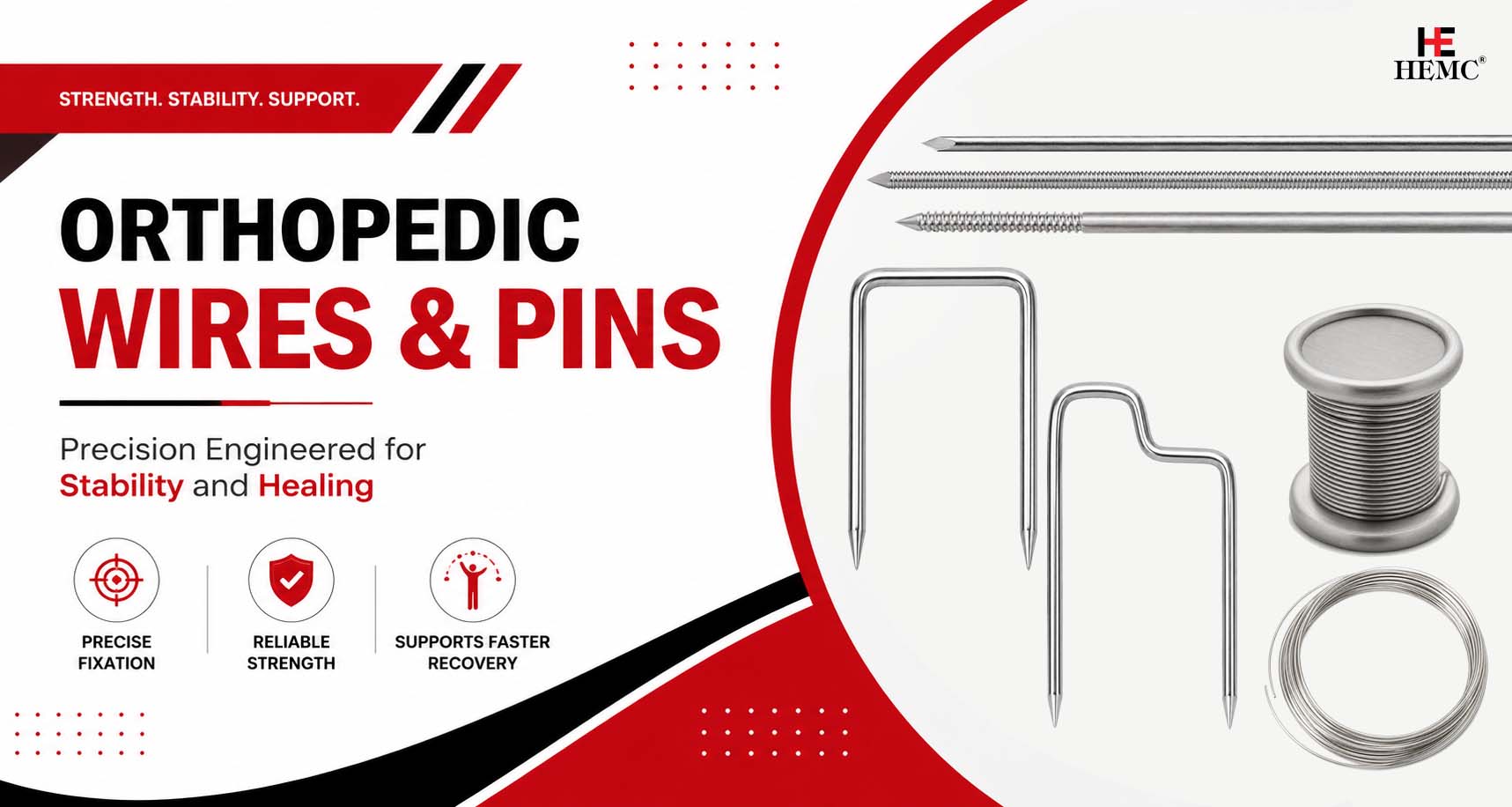
Understanding Wires and Pins in Orthopaedic Surgery
Wires and pins are metallic fixation devices designed to stabilize fractured bones or hold bone fragments in their correct anatomical position during healing. They are typically manufactured from medical-grade stainless steel or titanium to provide excellent strength, corrosion resistance, and biocompatibility.
Unlike larger fixation devices, wires and pins are minimally invasive and can often be inserted through small incisions, reducing tissue damage and promoting faster recovery.
They are widely used alongside other Orthopaedic implants, including Locking plates and screws, Nails, Interlocking nails, external fixators, and spinal implants.
Types of Orthopaedic Wires and Pins
Modern orthopedic surgery utilizes several varieties of wires and pins, each serving a unique purpose depending on the fracture pattern and surgical requirements.
Kirschner Wires (K-Wires)
Kirschner wires, commonly known as K-wires, are thin, smooth stainless steel wires used for temporary or permanent fixation of bone fragments. They are especially useful in:
- Hand fractures
- Wrist fractures
- Pediatric fractures
- Foot and ankle procedures
- Finger injuries
Their versatility makes them one of the most frequently used orthopedic fixation devices.
Steinmann Pins
Steinmann pins are thicker and stronger than K-wires. They provide greater stability and are commonly used for:
- Long bone fractures
- Skeletal traction
- External fixation systems
- Temporary stabilization during surgery
Guide Wires
Guide wires assist surgeons during minimally invasive procedures. They act as pathways for inserting larger implants such as:
- Interlocking nails
- Cannulated screws
- Intramedullary Nails
- Reaming systems
Guide wires ensure accurate implant placement while minimizing surgical trauma.
Cerclage Wires
Cerclage wires wrap around fractured bone fragments to provide compression and maintain alignment. They are frequently combined with Locking plates and screws during fracture fixation.
Importance of Wires and Pins in Fracture Management
Fracture healing depends on proper alignment and stabilization. Even slight movement between bone fragments can delay healing or cause malunion.
Wires and pins provide temporary or permanent stabilization that allows natural bone healing while maintaining proper anatomical positioning.
Their importance becomes particularly evident in fractures involving:
- Small bones
- Pediatric patients
- Comminuted fractures
- Joint fractures
- Open fractures
- Multiple trauma injuries
Orthopedic surgeons often rely on wires and pins before placing larger Orthopaedic implants, ensuring precise reduction of fracture fragments.
Role in Pediatric Orthaopedic Surgery
Children’s bones heal differently than adult bones. Their growth plates require careful handling to prevent long-term deformities.
Wires and pins are widely preferred in pediatric orthopedics because they:
- Cause minimal growth plate damage
- Require smaller incisions
- Can be removed after healing
- Reduce surgical complications
- Promote faster recovery
Conditions commonly treated include:
- Supracondylar humerus fractures
- Forearm fractures
- Finger injuries
- Elbow fractures
Their minimally invasive nature makes them ideal for growing bones.
Supporting Advanced Orthopaedic Implants
Although modern trauma surgery increasingly utilizes sophisticated fixation systems, wires and pins remain indispensable because they support the placement of larger implants.
For example:
Locking Plates and Screws
During fracture fixation using Locking plates and screws, surgeons often temporarily stabilize bone fragments with K-wires before permanently securing the plate.
This improves alignment and surgical accuracy.
Interlocking Nails
When inserting Interlocking nails, guide wires establish the correct entry point and maintain alignment throughout the procedure.
Without guide wires, achieving accurate intramedullary fixation would be significantly more challenging.
Intramedullary Nails
Modern Nails rely heavily on guide wire technology during insertion.
The guide wire determines:
- Nail trajectory
- Alignment
- Depth
- Positioning
This reduces complications while improving surgical precision.
Advantages of Wires and Pins
Several characteristics make wires and pins valuable in orthopaedic surgery.
Minimally Invasive
Smaller incisions reduce:
- Blood loss
- Soft tissue damage
- Infection risk
- Recovery time
- Versatile
They can be used in:
- Trauma surgery
- Sports injuries
- Pediatric orthopedics
- Hand surgery
- Foot surgery
- Spine surgery
- Reconstructive procedures
- Cost-Effective
Compared to larger fixation systems, wires and pins are relatively inexpensive while delivering excellent clinical outcomes.
Easy Removal
Many orthopaedic wires can be removed after complete bone healing without requiring major surgery.
High Strength
Manufactured using surgical-grade stainless steel or titanium, they provide reliable mechanical support during bone healing.
Applications Across Orthopaedic Specialties
Trauma Surgery
Trauma surgeons use wires and pins for:
- Temporary fracture stabilization
- Definitive fixation
- External fixator assembly
- Open fracture management
Hand Surgery
Small bones require delicate fixation techniques.
Wires and pins are commonly used for:
- Metacarpal fractures
- Phalangeal fractures
- Tendon reconstruction
- Joint stabilization
Foot and Ankle Surgery
They stabilize:
- Toe fractures
- Midfoot injuries
- Ankle fractures
- Corrective osteotomies
Spine Surgery
Although spinal procedures primarily rely on advanced Orthopaedic implants, wires may assist in specific stabilization techniques and instrumentation during complex reconstructions.
Sports Medicine
Sports-related fractures frequently involve minimally displaced bone injuries.
Wires and pins help restore bone stability while preserving surrounding tissues.
Combination with External Fixators
External fixation systems frequently incorporate wires and pins to stabilize fractures without extensive surgical exposure.
These systems are especially useful for:
- Open fractures
- Severe soft tissue injuries
- Polytrauma patients
- Limb lengthening
- Deformity correction
Pins connect the bone to the external frame, providing stable fixation while allowing wound care.
Materials Used in Orthopaedic Wires and Pins
The performance of orthopedic implants depends heavily on material quality.
Most wires and pins are manufactured from:
Stainless Steel
Benefits include:
- Excellent strength
- Corrosion resistance
- Cost-effectiveness
- High durability
Titanium
Titanium offers:
- Superior biocompatibility
- Lightweight construction
- Excellent corrosion resistance
- MRI compatibility
- Reduced allergic reactions
These materials ensure long-term reliability while minimizing complications.
Surgical Technique and Precision
Successful orthopedic surgery depends on accurate implant placement.
Surgeons use fluoroscopy, navigation systems, and specialized instruments to insert wires and pins precisely.
Proper technique minimizes:
- Neurovascular injury
- Implant migration
- Infection
- Malalignment
- Delayed healing
Training and surgical experience remain essential for achieving optimal outcomes.
Benefits for Patients
Patients benefit significantly from the use of wires and pins.
These include:
- Smaller surgical wounds
- Faster recovery
- Reduced pain
- Less blood loss
- Better fracture stability
- Earlier rehabilitation
- Improved functional outcomes
Many patients begin controlled movement sooner, reducing stiffness and muscle wasting.
Potential Complications
Like all Orthopaedic implants, wires and pins may occasionally lead to complications if not properly managed.
Possible complications include:
- Pin tract infection
- Wire migration
- Loosening
- Breakage
- Skin irritation
- Delayed union
Fortunately, modern surgical techniques and proper postoperative care significantly reduce these risks.
Routine follow-up allows early detection and management of any complications.
Future Developments in Orthopaedic Fixation
Orthopedic technology continues to evolve rapidly.
Current research focuses on:
- Bioabsorbable pins
- Smart implants with sensors
- Advanced titanium alloys
- Antibacterial implant coatings
- Patient-specific fixation systems
- 3D-printed orthopedic implants
Even with these innovations, conventional wires and pins remain essential because of their simplicity, effectiveness, and affordability.
They continue to complement advanced fixation devices such as Locking plates and screws, Interlocking nails, and intramedullary Nails, ensuring surgeons have the right tools for every clinical situation.
Choosing High-Quality Orthopaedic Implants
The success of fracture fixation depends not only on surgical expertise but also on implant quality.
Healthcare providers should select orthopaedic implants that meet international quality standards and are manufactured using premium medical-grade materials.
Reliable manufacturers offer:
- Precision-engineered wires and pins
- Certified stainless steel and titanium materials
- Comprehensive implant systems
- Consistent quality control
- Sterile and non-sterile options
- Compatibility with modern surgical instruments
Investing in high-quality implants ultimately improves patient safety and long-term clinical outcomes.
Conclusion
Despite the continuous advancement of orthopaedic technology, wires and pins remain among the most essential tools in orthopaedic surgery. Their versatility, simplicity, and reliability make them indispensable for fracture fixation, temporary stabilization, pediatric procedures, hand surgery, trauma care, and reconstructive operations.
When combined with advanced Orthopaedic implants such as Locking plates and screws, Interlocking nails, and intramedullary Nails, wires and pins provide surgeons with unmatched flexibility and precision during surgery. Their minimally invasive nature, excellent mechanical performance, and affordability continue to make them a preferred choice in hospitals and trauma centers worldwide.
As orthopedic science advances with innovative materials and smarter implant technologies, wires and pins will continue to play a vital supporting role in achieving stable fixation, faster bone healing, and improved patient outcomes. Their enduring importance highlights why they remain foundational components of modern orthopaedic practice and comprehensive fracture management.