

Proximal humerus fractures are among the most common upper-limb injuries, especially in elderly patients with osteoporosis and younger individuals who suffer high-energy trauma. Treating these fractures requires precision, stability, and implants designed to support rapid healing while preserving shoulder function. Among the latest innovations in Orthopaedic implants, the Locking Proximal Humerus Altos Plate has become a preferred solution for orthopedic surgeons worldwide.
Designed with advanced locking technology, anatomical contouring, and superior fixation strength, Altos Plates provide excellent outcomes even in complex fracture patterns. Their innovative design minimizes complications, improves stability, and allows early mobilization, making them an ideal choice for both surgeons and patients.
Understanding Proximal Humerus Fractures
The proximal humerus forms the upper part of the arm bone and plays a critical role in shoulder movement. Fractures in this region can result from falls, sports injuries, road accidents, or osteoporosis-related trauma.
Depending on the fracture pattern, treatment options may include conservative management or surgical fixation. Complex fractures often require internal fixation using specially designed Orthopaedic implants that restore alignment and provide stable support throughout the healing process.
This is where the Locking Proximal Humerus Altos Plate offers significant clinical advantages.
What is a Locking Proximal Humerus Altos Plate?
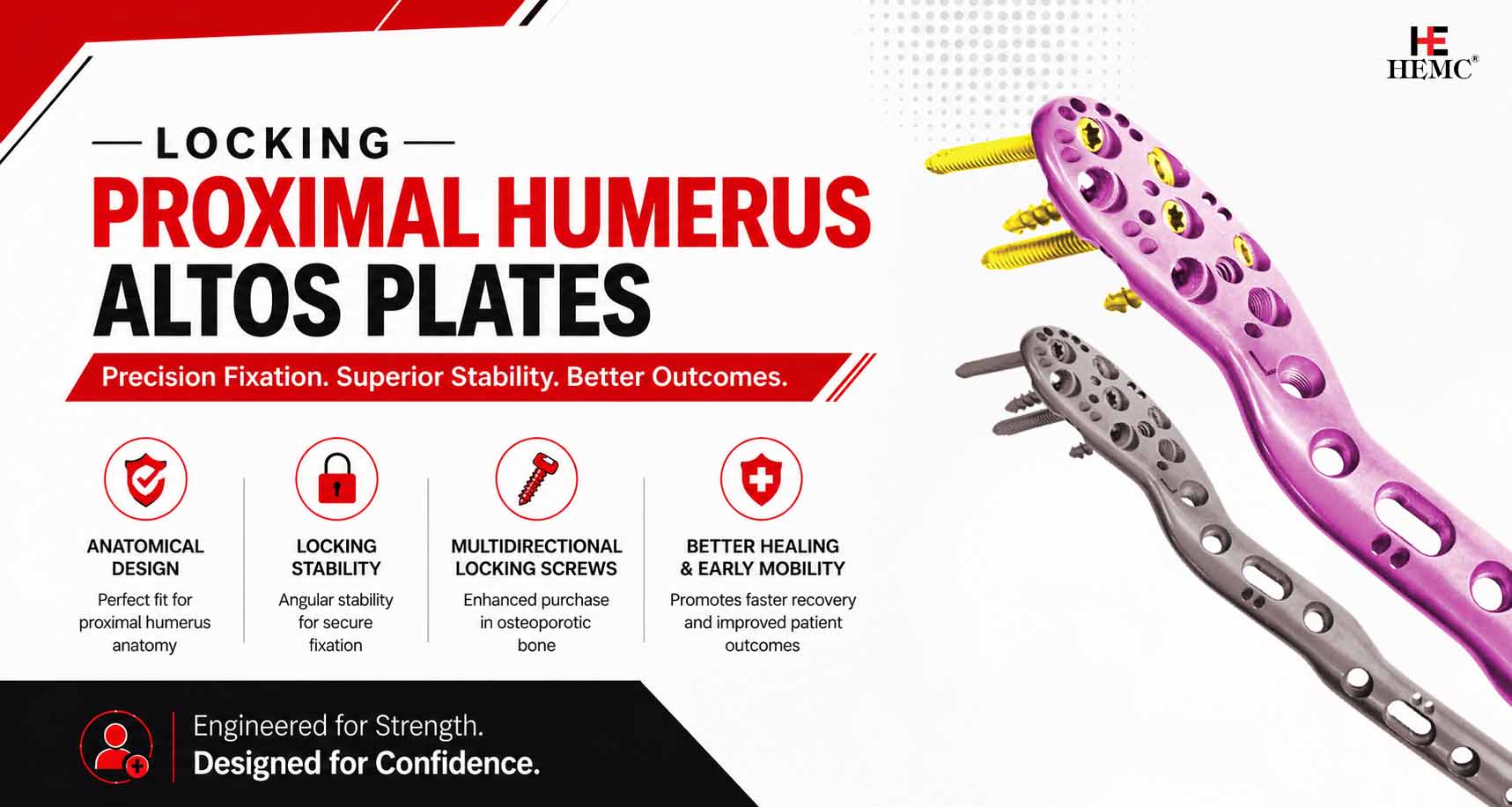
The Locking Proximal Humerus Altos Plate is an anatomically pre-contoured implant engineered specifically for fractures of the proximal humerus. Manufactured from high-quality stainless steel or titanium alloy, it provides rigid fixation through multiple locking screw options that secure the fracture fragments effectively.
Unlike conventional plates, Altos Plates utilize fixed-angle locking technology, creating a stable construct that is particularly beneficial in osteoporotic bone where screw purchase is often compromised.
This advanced design helps maintain fracture reduction while reducing the risk of implant loosening and fixation failure.
Why Choose Locking Proximal Humerus Altos Plates?
Anatomically Contoured Design
One of the biggest advantages of Altos Plates is their anatomical shape.
The plate closely matches the natural anatomy of the proximal humerus, reducing the need for excessive intraoperative bending. Better anatomical fit minimizes soft tissue irritation and allows accurate fracture reduction.
Benefits include:
- Reduced surgical time
- Improved implant positioning
- Better patient comfort
- Lower risk of soft tissue complications
Superior Locking Technology
The biggest advancement in modern Locking plates and screws is the fixed-angle locking mechanism.
Each locking screw threads directly into the plate, creating a stable internal framework rather than relying solely on bone compression.
Advantages include:
- Increased angular stability
- Better fixation in osteoporotic bone
- Reduced screw loosening
- Improved load distribution
- Enhanced fracture stability
This technology significantly improves healing outcomes compared to conventional plating systems.
Excellent Support for Osteoporotic Bone
Elderly patients often suffer from reduced bone density, making fracture fixation particularly challenging.
The Locking Proximal Humerus Altos Plate provides excellent stability even in poor-quality bone because the locking construct functions as a single stable unit.
This minimizes:
- Implant pull-out
- Screw loosening
- Secondary displacement
- Loss of fracture reduction
As a result, surgeons can confidently treat elderly patients with improved success rates.
Multiple Screw Placement Options
Modern Altos Plates feature numerous multidirectional screw holes that allow surgeons to optimize screw placement based on individual fracture configurations.
The locking screws can securely capture small fracture fragments, including:
- Greater tuberosity
- Lesser tuberosity
- Humeral head fragments
This versatility enables stable fixation even in highly comminuted fractures.
Improved Early Mobilization
Stable fixation allows patients to begin controlled shoulder exercises earlier.
Early mobilization offers several advantages:
- Reduced joint stiffness
- Faster rehabilitation
- Improved muscle strength
- Better range of motion
- Enhanced functional recovery
Early rehabilitation has become one of the major goals in modern orthopedic trauma surgery.
Reduced Risk of Implant Failure
Traditional plating systems may fail due to screw loosening or loss of fixation.
The fixed-angle construct of the Locking Proximal Humerus Altos Plate dramatically reduces these complications by creating a stronger mechanical interface between the plate and screws.
This results in:
- Improved durability
- Better fracture alignment
- Lower revision rates
- Greater surgical confidence
Clinical Applications
The Locking Proximal Humerus Altos Plate is commonly used for treating:
- Two-part proximal humerus fractures
- Three-part fractures
- Four-part fractures
- Osteoporotic fractures
- Complex comminuted fractures
- Fracture-dislocations
- Malunions requiring reconstruction
Its versatility makes it suitable for a wide range of clinical situations.
Material Quality and Biocompatibility
Modern Orthopaedic implants are manufactured using premium-grade stainless steel and titanium alloys.
These materials offer:
- Excellent corrosion resistance
- High mechanical strength
- Long-term durability
- Superior biocompatibility
- Reduced allergic reactions
Titanium variants also provide lightweight construction and improved compatibility with medical imaging.
Integration with Modern Orthopaedic Implant Systems
The Locking Proximal Humerus Altos Plate is one component of a comprehensive orthopedic trauma portfolio.
Today’s hospitals frequently use multiple implant systems together, including:
Surgical Advantages for Orthopedic Surgeons
The Locking Proximal Humerus Altos Plate simplifies surgical procedures by offering:
- Pre-contoured anatomy
- Easy instrumentation
- Multiple screw trajectories
- Reliable fixation
- Consistent clinical outcomes
These features reduce operative complexity while improving precision during fracture reconstruction.
Benefits for Patients
Patients undergoing fixation with Altos Plates may experience several benefits, including:
- Reduced postoperative pain
- Better fracture stability
- Faster recovery
- Improved shoulder function
- Earlier return to daily activities
- Lower complication rates
- Enhanced long-term outcomes
When combined with appropriate rehabilitation, these benefits contribute to higher patient satisfaction.
Rehabilitation After Surgery
Successful treatment does not end with surgery.
A structured rehabilitation program is essential for restoring shoulder mobility and strength.
Typical rehabilitation includes:
- Passive range-of-motion exercises
- Assisted shoulder movements
- Progressive strengthening
- Functional training
- Regular follow-up imaging
Stable fixation provided by the Locking Proximal Humerus Altos Plate allows rehabilitation protocols to begin earlier under medical supervision.
Choosing the Right Orthopaedic Implants
Selecting appropriate Orthopaedic implants depends on several factors:
- Patient age
- Bone quality
- Fracture type
- Surgeon preference
- Implant quality
- Surgical expertise
Hospitals increasingly prefer trusted implant manufacturers that provide complete trauma systems including Locking plates and screws, Interlocking nails, Spine Implants, Nails, Pins & Wire, and specialized implants like the Locking Proximal Humerus Altos Plate.
Future of Locking Plate Technology
Orthopedic implant technology continues to evolve with improvements such as:
- Enhanced titanium alloys
- Variable-angle locking systems
- Low-profile plate designs
- Better anatomical contouring
- Improved surgical instruments
- Advanced manufacturing techniques
Future developments will further improve fracture healing while reducing complications and recovery time.
Conclusion
The Locking Proximal Humerus Altos Plate represents a significant advancement in modern fracture fixation. Its anatomical design, superior locking technology, excellent stability, and reliable clinical performance make it an outstanding choice for treating proximal humerus fractures.
Whether managing osteoporotic fractures in elderly patients or complex traumatic injuries in younger individuals, Altos Plates provide dependable fixation that supports early mobilization and improved functional recovery.
As part of a complete portfolio of advanced Orthopaedic implants, including Locking plates and screws, Interlocking nails, Spine Implants, and Nails, Pins & Wire, the Locking Proximal Humerus Altos Plate continues to help surgeons achieve predictable surgical outcomes and better patient satisfaction. By combining innovative implant design with proven clinical performance, it has become a trusted solution for orthopedic trauma specialists seeking reliable, long-lasting fracture fixation.