

Clavicle fractures are among the most common shoulder injuries, accounting for a significant percentage of fractures in both young athletes and elderly patients. While many clavicle fractures heal with conservative treatment, complex fractures involving the lateral clavicle or acromioclavicular (AC) joint often require surgical intervention. Modern orthopaedic implants have transformed the treatment of these injuries by providing stable fixation, faster healing, and improved patient outcomes.
Among these advanced fixation devices, the Locking Clavicle Hook Plate has become one of the most effective solutions for stabilizing distal clavicle fractures and AC joint dislocations. Designed with anatomical precision and manufactured from high-quality materials, this implant provides excellent fixation while preserving the natural biomechanics of the shoulder.
Understanding Clavicle Fractures
The clavicle, commonly known as the collarbone, connects the shoulder to the sternum and plays a vital role in upper limb movement and stability. Due to its exposed position, it is highly susceptible to fractures caused by:
- Sports injuries
- Road traffic accidents
- Falls onto the shoulder
- High-impact trauma
- Workplace accidents
Most clavicle fractures occur in the middle third of the bone, while fractures near the lateral end are often unstable because of ligament injuries and muscular forces acting on the fragments.
Unstable distal clavicle fractures generally require surgical fixation to restore alignment and shoulder function.
What Is a Locking Clavicle Hook Plate?
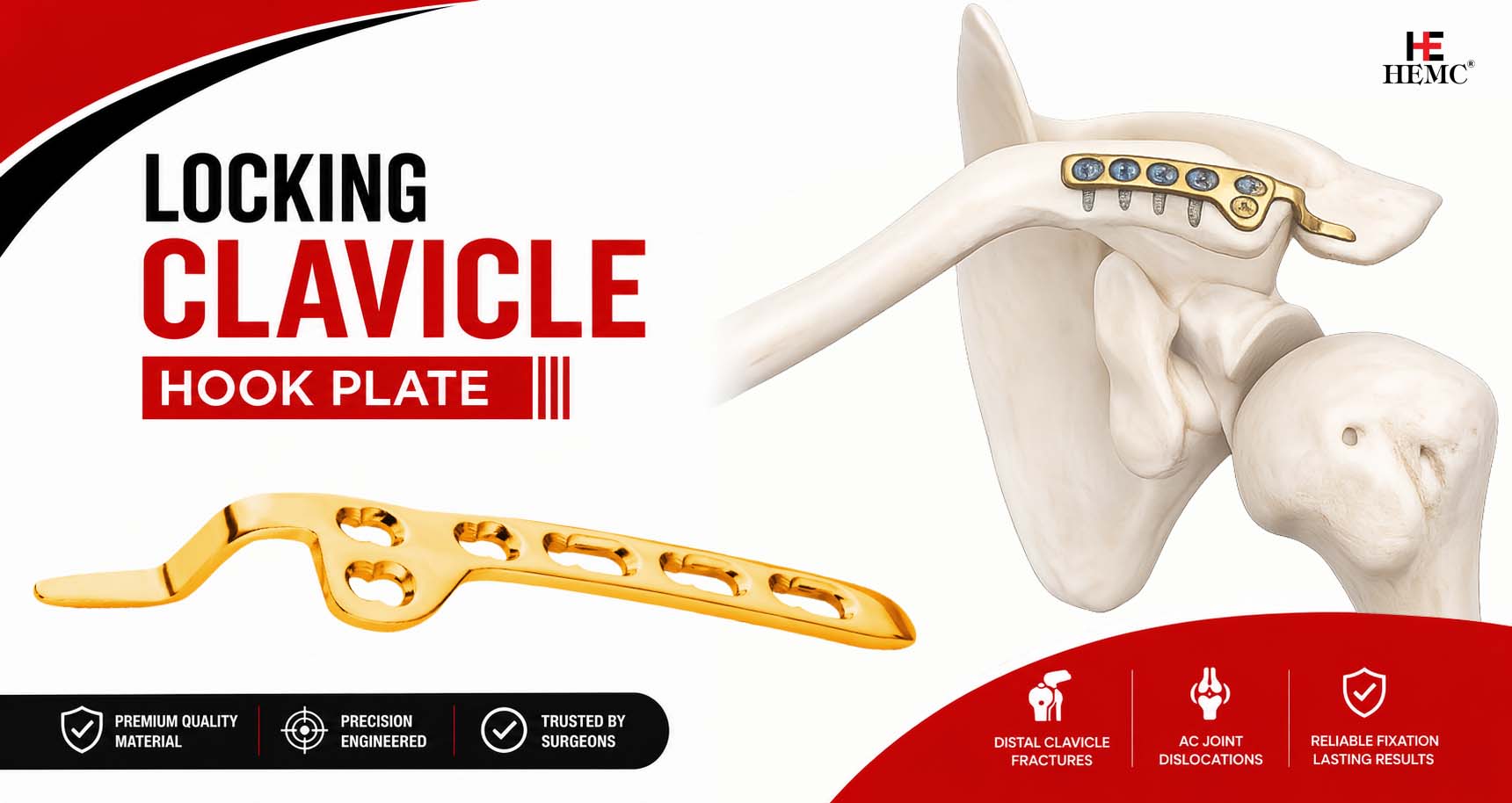
A Locking Clavicle Hook Plate is a specially designed orthopedic fixation implant intended for treating unstable distal clavicle fractures and acromioclavicular joint injuries. The plate features a hook that slides beneath the acromion, providing support while maintaining the correct alignment of the clavicle during healing.
Unlike conventional fixation systems, locking technology creates a fixed-angle construct where the screws lock firmly into the plate. This significantly improves stability, particularly in osteoporotic bone and comminuted fractures.
The hook design supports the distal fragment without relying solely on bone quality, making it particularly effective for fractures with small lateral fragments.
Key Features
Modern locking clavicle hook plates offer numerous advanced design characteristics, including:
- Anatomically contoured profile
- Low-profile construction
- Multiple locking screw holes
- Fixed-angle stability
- High-strength titanium or stainless steel construction
- Smooth hook design for acromial support
- Left and right anatomical variants
- Various plate lengths for different fracture patterns
These features help surgeons achieve secure fixation while minimizing soft tissue irritation.
Advantages of Locking Clavicle Hook Plate
Superior Stability
- The combination of locking technology and hook support provides exceptional fracture stabilization.
Strong Angular Fixation
- The integration of locking plates and screws creates a rigid construct that minimizes micromotion at the fracture site.
Suitable for Osteoporotic Bone
- Since the screws lock directly into the plate, fixation strength does not rely entirely on bone density.
Early Rehabilitation
- Stable fixation allows patients to begin controlled shoulder movements earlier than with many traditional fixation methods.
Anatomical Fit
- Modern implants closely match the natural clavicle anatomy, reducing the need for excessive intraoperative bending.
Reduced Risk of Implant Failure
- The fixed-angle design distributes mechanical loads more evenly across the construct, lowering the likelihood of screw loosening or plate breakage.
Clinical Indications
Locking clavicle hook plates are commonly indicated for:
- Distal clavicle fractures
- Neer Type II clavicle fractures
- Unstable lateral clavicle fractures
- Acromioclavicular joint dislocations
- Nonunion of distal clavicle fractures
- Delayed union
- Revision surgeries
- Ligament-associated clavicle injuries
The implant is particularly valuable when the distal fragment is too small for conventional plating techniques.
Surgical Procedure Overview
The surgical procedure typically includes:
Preoperative Planning
- Radiographic imaging and CT scans help determine fracture configuration and implant selection.
Patient Positioning
- The patient is generally positioned in the beach-chair position to provide optimal surgical access.
Fracture Reduction
- The fractured bone fragments are carefully realigned to restore normal clavicular anatomy.
Plate Placement
- The hook portion is inserted beneath the acromion while the plate rests along the superior aspect of the clavicle.
Screw Fixation
- Multiple locking plates and screws secure the implant firmly to the bone, creating a stable fixation construct.
Wound Closure
Following confirmation of implant position using fluoroscopy, the incision is closed in layers.
Postoperative Care
Successful outcomes depend on both surgical fixation and proper rehabilitation.
Typical recovery includes:
- Sling immobilization during the initial healing phase
- Pain management
- Gradual passive shoulder exercises
- Progressive active range-of-motion exercises
- Muscle strengthening
- Follow-up radiographs
Depending on fracture healing and patient activity, hook plate removal may be recommended after union to prevent long-term subacromial irritation.
Materials Used in Manufacturing
Modern orthopaedic implants are manufactured using premium biomaterials such as:
- Titanium Alloy
- Medical-grade Stainless Steel
These materials provide:
- Excellent corrosion resistance
- High fatigue strength
- Superior biocompatibility
- Long-term mechanical reliability
- MRI compatibility (Titanium)
Complementary Clavicle Implant Systems
Although the locking clavicle hook plate is ideal for many distal clavicle fractures, several specialized clavicle fixation systems are available depending on fracture location.
Locking Clavicle Collar Plate
- The locking clavicle collar plate is designed specifically for fractures involving different regions of the clavicle where hook fixation may not be necessary. Its anatomical contour provides stable fixation while preserving bone alignment and minimizing soft tissue irritation.
Locking Superior-Anterior Clavicle Plate
- The locking superior-anterior clavicle plate offers enhanced fixation for fractures involving the shaft and midshaft of the clavicle. Positioned along the superior-anterior surface, this implant provides excellent stability while accommodating the natural S-shaped anatomy of the clavicle.
Locking Superior-Anterior Clavicle Plate with Lateral Extension
- For fractures extending toward the lateral clavicle, the locking superior-anterior clavicle plate with lateral extension offers additional fixation options. The lateral extension incorporates multiple locking screw holes, allowing secure fixation of small distal fragments that are otherwise difficult to stabilize.
These specialized implant designs enable orthopedic surgeons to select the most appropriate fixation system based on fracture pattern and patient anatomy.
Importance of Locking Plates and Screws
Modern fracture fixation increasingly relies on locking plates and screws because they provide significant biomechanical advantages over conventional plating systems.
Key benefits include:
- Fixed-angle stability
- Reduced screw loosening
- Better load distribution
- Improved fixation in osteoporotic bone
- Enhanced resistance to pull-out
- Increased construct rigidity
- Reduced need for precise plate-to-bone compression
These advantages contribute to improved fracture healing and reduced complication rates.
Potential Complications
Although outcomes are generally excellent, potential complications may include:
- Infection
- Implant irritation
- Subacromial impingement
- Acromial erosion
- Delayed union
- Nonunion
- Implant loosening
- Hardware failure
- Shoulder stiffness
Careful surgical technique and proper implant selection help minimize these risks.
Rehabilitation and Functional Recovery
Rehabilitation is an essential part of successful clavicle fracture treatment.
A structured rehabilitation program typically progresses through several phases:
Phase 1 (0–2 Weeks)
- Pain control
- Sling support
- Gentle pendulum exercises
Phase 2 (2–6 Weeks)
- Passive range-of-motion exercises
- Gradual shoulder mobility
- Scapular strengthening
Phase 3 (6–12 Weeks)
- Active strengthening exercises
- Functional shoulder training
- Progressive resistance exercises
Phase 4 (After Union)
- Return to sports
- Heavy lifting
- Occupational activities
- Full shoulder function restoration
Recovery timelines vary depending on fracture severity, patient age, and overall health.
Why Quality Orthopaedic Implants Matter
Selecting premium orthopaedic implants is critical for achieving optimal surgical outcomes. High-quality implants undergo rigorous manufacturing processes, precision machining, and strict quality control to ensure safety, durability, and reliable performance.
Surgeons often prefer implants that provide:
- Anatomical contouring
- Precision locking technology
- High-strength materials
- Comprehensive size options
- Excellent surgical handling
- Proven clinical performance
These characteristics improve operative efficiency and support long-term patient recovery.
Conclusion
The Locking Clavicle Hook Plate remains one of the most dependable solutions for treating unstable distal clavicle fractures and acromioclavicular joint injuries. Its innovative hook design, combined with advanced locking plates and screws, delivers exceptional fixation stability, promotes reliable bone healing, and supports early rehabilitation.
In addition to hook plates, specialized systems such as the locking clavicle collar plate, locking superior-anterior clavicle plate, and locking superior-anterior clavicle plate with lateral extension provide orthopedic surgeons with versatile treatment options for a wide range of clavicle fracture patterns.
As modern orthopaedic implants continue to evolve, patients benefit from improved implant designs, enhanced surgical precision, faster recovery, and better long-term functional outcomes. Choosing high-quality clavicle fixation systems allows surgeons to restore shoulder stability, reduce complications, and help patients return to their normal activities with confidence.