

The treatment of complex fractures has evolved significantly with the advancement of orthopaedic implants, enabling surgeons to achieve better fixation, faster recovery, and improved patient outcomes. Among these innovations, the Locking Medial Distal Tibia Plate with Tab has become an essential implant for managing distal tibial fractures, especially those involving metaphyseal and periarticular regions.
Designed to provide stable fixation in challenging anatomical areas, this implant combines anatomical contouring, locking technology, and additional support through a tab mechanism, making it a preferred choice in modern trauma surgery. As healthcare facilities increasingly adopt advanced Locking Plates and Screws, the role of specialized implants like the Locking Medial Distal Tibia Plate with Tab continues to grow alongside other solutions such as Interlocking Nails, Spine Implants, and External Fixators.
Understanding Distal Tibia Fractures
The distal tibia forms the lower segment of the shinbone near the ankle joint. Fractures in this region are particularly challenging because of:
- Limited soft tissue coverage
- Complex anatomy
- Proximity to the ankle joint
- High risk of complications
- Difficulty in achieving stable fixation
Distal tibial fractures commonly occur due to:
- Road traffic accidents
- Sports injuries
- Falls from height
- Industrial trauma
- Osteoporotic bone conditions in elderly patients
These injuries often require advanced orthopaedic implants that provide rigid stability without compromising blood supply or surrounding tissues.
What Is a Locking Medial Distal Tibia Plate with Tab?
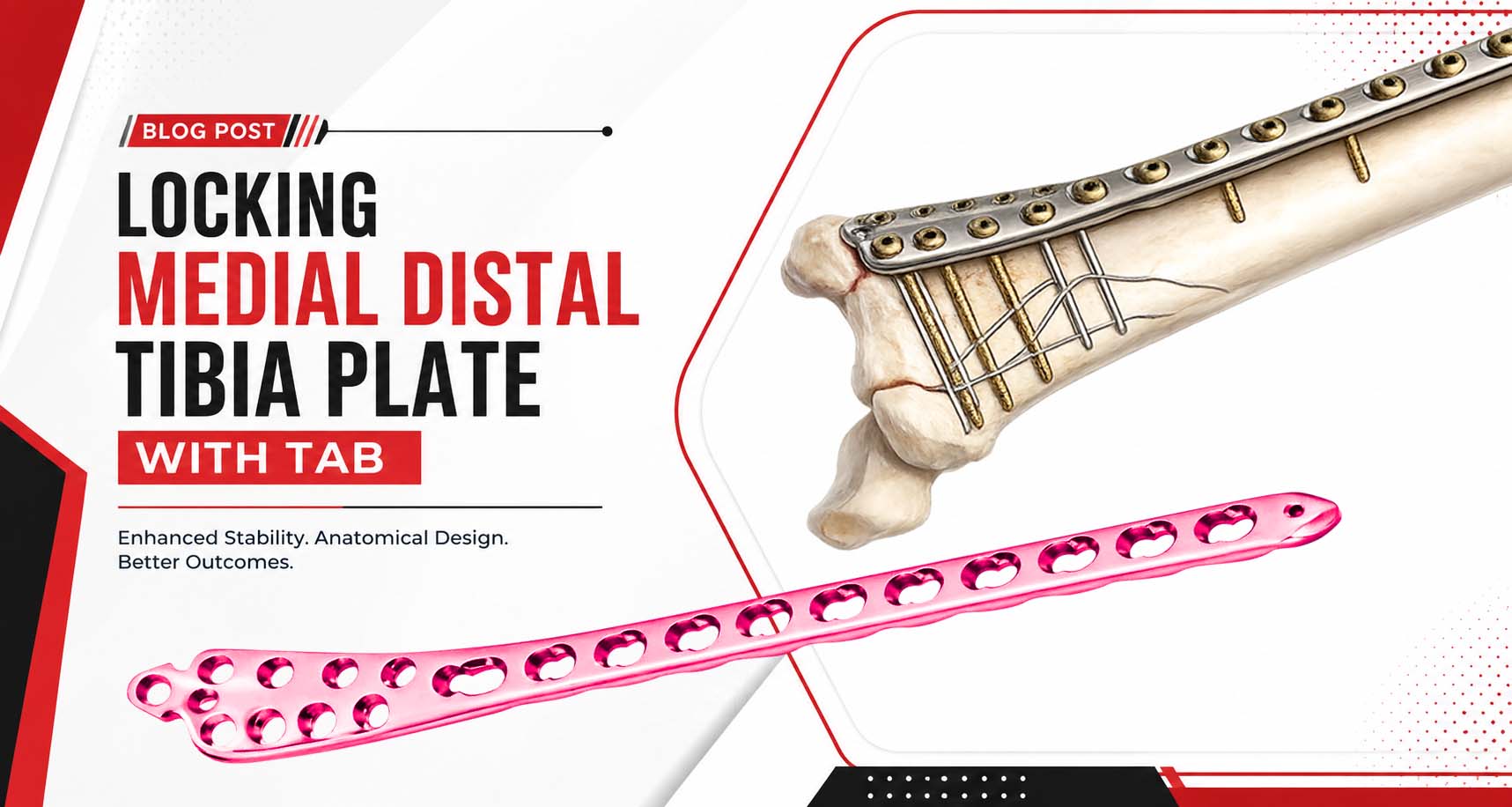
A Locking Medial Distal Tibia Plate with Tab is an anatomically designed fixation device intended for fractures occurring on the medial aspect of the distal tibia. The additional tab provides enhanced fixation possibilities for specific fracture patterns and helps secure small bone fragments that might otherwise be difficult to stabilize.
The implant works with specialized Locking Plates and Screws, creating a fixed-angle construct that improves stability, particularly in:
- Comminuted fractures
- Osteoporotic bone
- Periarticular injuries
- Multi-fragment fractures
- High-energy trauma cases
The plate’s anatomical contour minimizes the need for intraoperative bending, reducing surgical time and preserving structural integrity.
Key Design Features
Anatomically Contoured Structure
- The plate is specifically shaped to match the natural anatomy of the medial distal tibia, allowing precise placement and minimizing soft tissue irritation.
Locking Screw Technology
- The threaded screw holes accept locking screws that create angular stability between the screw and plate, improving fixation strength.
Additional Tab Mechanism
The tab portion offers supplementary support for:
- Small distal fragments
- Medial malleolar involvement
- Complex fracture configurations
- Enhanced rotational stability
Multiple Distal Screw Options
- The distal segment typically includes numerous screw holes arranged to maximize purchase in the metaphyseal bone.
High-Quality Material Construction
- Most manufacturers produce these implants using:
- Surgical-grade stainless steel
- Titanium alloys
- Biocompatible corrosion-resistant materials
These materials ensure long-term durability and excellent patient compatibility.
Indications for Locking Medial Distal Tibia Plates with Tab
The implant is commonly used for:
Distal Tibial Metaphyseal Fractures
- These fractures occur near the ankle and require stable fixation to maintain alignment during healing.
Intra-Articular Fractures
- When fractures extend into the ankle joint, precise reconstruction and stable fixation become critical.
Osteoporotic Bone Conditions
- The fixed-angle nature of Locking Plates and Screws makes them highly effective in weak or osteoporotic bones.
Comminuted Fractures
- Multiple bone fragments require advanced stabilization methods, which locking technology effectively provides.
Malunions and Non-Unions
- Corrective procedures often utilize locking plates to achieve stable fixation during revision surgeries.
Advantages of Locking Medial Distal Tibia Plates with Tab
Superior Angular Stability
Unlike conventional plating systems, locking constructs create a rigid framework that resists:
- Rotational forces
- Axial loading
- Bending stresses
- Varus and valgus displacement
This stability is particularly beneficial in complex trauma cases.
Preservation of Blood Supply
- Modern minimally invasive techniques allow surgeons to insert the plate without extensive soft tissue stripping, preserving periosteal circulation and promoting faster healing.
Enhanced Fixation in Osteoporotic Bone
- Traditional screws rely on bone quality for stability. In contrast, Locking Plates and Screws create a fixed-angle construct that provides excellent support even in compromised bone.
Reduced Risk of Implant Failure
- The locking mechanism distributes mechanical forces across the entire construct, minimizing the likelihood of:
- Screw loosening
- Plate breakage
- Secondary displacement
- Loss of reduction
- Faster Rehabilitation
Stable fixation allows earlier mobilization and functional recovery, reducing complications associated with prolonged immobilization.
Surgical Technique Overview
The surgical procedure typically involves several important steps.
Patient Positioning
- Patients are positioned supine with appropriate support to allow clear access to the distal tibia and ankle region.
Fracture Reduction
The surgeon carefully restores:
- Length
- Rotation
- Alignment
- Articular congruity
Accurate reduction is essential for optimal outcomes.
Plate Placement
- The Locking Medial Distal Tibia Plate with Tab is positioned along the medial surface of the tibia.
- Modern minimally invasive plate osteosynthesis (MIPO) techniques often minimize soft tissue disruption during implantation.
Screw Insertion
- Both locking and conventional screws may be used depending on the fracture characteristics.
- The tab region allows additional fixation of smaller fracture fragments that require specialized support.
Postoperative Imaging
Radiographs confirm:
- Plate position
- Screw placement
- Fracture alignment
- Joint congruity
Comparison with Other Orthopaedic Fixation Systems
Modern trauma management utilizes various orthopaedic implants, each designed for specific clinical situations.
Locking Plates and Screws
These systems provide:
- Fixed-angle stability
- Better osteoporotic fixation
- Reduced implant loosening
- Enhanced biomechanical performance
The Locking Medial Distal Tibia Plate with Tab represents an advanced application of this technology.
Interlocking Nails
Interlocking Nails are commonly used for:
- Diaphyseal tibial fractures
- Femoral shaft fractures
- Humeral fractures
While highly effective for shaft injuries, distal metaphyseal fractures often require locking plate systems due to the complexity of the anatomy and need for precise articular reconstruction.
External Fixators
External Fixators play an important role in:
- Open fractures
- Severe soft tissue injuries
- Temporary stabilization
- Damage control orthopaedics
Once soft tissues recover, definitive fixation using locking plates may be performed.
Spine Implants
- Although Spine Implants serve entirely different anatomical regions, they share similar principles of stability, biomechanical optimization, and anatomical restoration.
Modern spinal systems utilize advanced locking mechanisms comparable to those found in contemporary trauma implants.
Role in Minimally Invasive Orthopaedic Surgery
Minimally invasive surgical techniques have transformed fracture management.
The Locking Medial Distal Tibia Plate with Tab is particularly suitable for MIPO procedures because it offers:
- Smaller incisions
- Reduced blood loss
- Lower infection rates
- Faster healing
- Improved cosmetic outcomes
By preserving the biological environment around the fracture, surgeons can optimize bone healing while minimizing complications.
Importance of Material Selection
The effectiveness of any orthopaedic implants depends significantly on material quality.
Stainless Steel Implants
Advantages include:
- High strength
- Cost-effectiveness
- Excellent durability
- Proven clinical performance
- Titanium Implants
Benefits include:
- Superior biocompatibility
- Reduced weight
- Greater corrosion resistance
- Enhanced MRI compatibility
Both materials remain widely used in trauma surgery, depending on surgeon preference and patient requirements.
Rehabilitation Following Surgery
Successful outcomes depend not only on surgical fixation but also on comprehensive rehabilitation programs.
Initial Recovery Phase
During the first few weeks:
- Swelling management is prioritized
- Range-of-motion exercises begin
- Weight-bearing restrictions are maintained
- Regular follow-up imaging is performed
Progressive Mobilization
- As healing progresses, patients gradually transition to:
- Partial weight-bearing
- Strengthening exercises
- Balance training
- Functional rehabilitation activities
Full Recovery
Most patients eventually regain:
- Normal walking ability
- Improved ankle function
- Reduced pain
- Enhanced quality of life
Stable fixation using advanced Locking Plates and Screws contributes significantly to these positive outcomes.
Challenges in Distal Tibia Fracture Management
Despite modern advancements, distal tibia fractures continue to present several challenges:
Soft Tissue Complications
The limited soft tissue envelope increases the risk of:
- Wound problems
- Infection
- Delayed healing
- Complex Fracture Patterns
High-energy injuries frequently produce:
- Comminution
- Articular involvement
- Segmental defects
- Associated fibular fractures
Biomechanical Demands
The distal tibia experiences significant mechanical forces during daily activities, requiring robust fixation solutions.
The Locking Medial Distal Tibia Plate with Tab addresses many of these challenges through its specialized design and advanced locking technology.
Future Trends in Orthopaedic Implant Technology
The field of orthopaedic implants continues to evolve rapidly.
Emerging developments include:
Patient-Specific Implants
- Customized implants based on 3D imaging offer improved anatomical fit and surgical precision.
Advanced Biomaterials
Research focuses on materials that promote:
- Faster bone healing
- Reduced infection rates
- Better biological integration
Smart Implant Technology
Future systems may incorporate sensors that monitor:
- Healing progress
- Mechanical loading
- Implant performance
Improved Locking Mechanisms
- Innovations in Locking Plates and Screws continue to enhance fixation stability while simplifying surgical procedures.
- These advancements complement other technologies such as Interlocking Nails, Spine Implants, and External Fixators, contributing to more comprehensive orthopaedic care.
Conclusion
The Locking Medial Distal Tibia Plate with Tab represents a significant advancement in the treatment of complex distal tibial fractures. Its anatomical design, fixed-angle stability, and additional tab support provide surgeons with an effective solution for managing challenging fracture patterns while preserving soft tissue integrity and promoting optimal healing.
As modern orthopaedic implants continue to evolve, specialized systems like this plate work alongside Locking Plates and Screws, Interlocking Nails, Spine Implants, and External Fixators to deliver comprehensive treatment options across the spectrum of musculoskeletal injuries.
By combining biomechanical strength, minimally invasive techniques, and advanced material technology, the Locking Medial Distal Tibia Plate with Tab remains an indispensable component of contemporary orthopaedic trauma surgery, helping patients achieve faster recovery, improved mobility, and better long-term outcomes.