


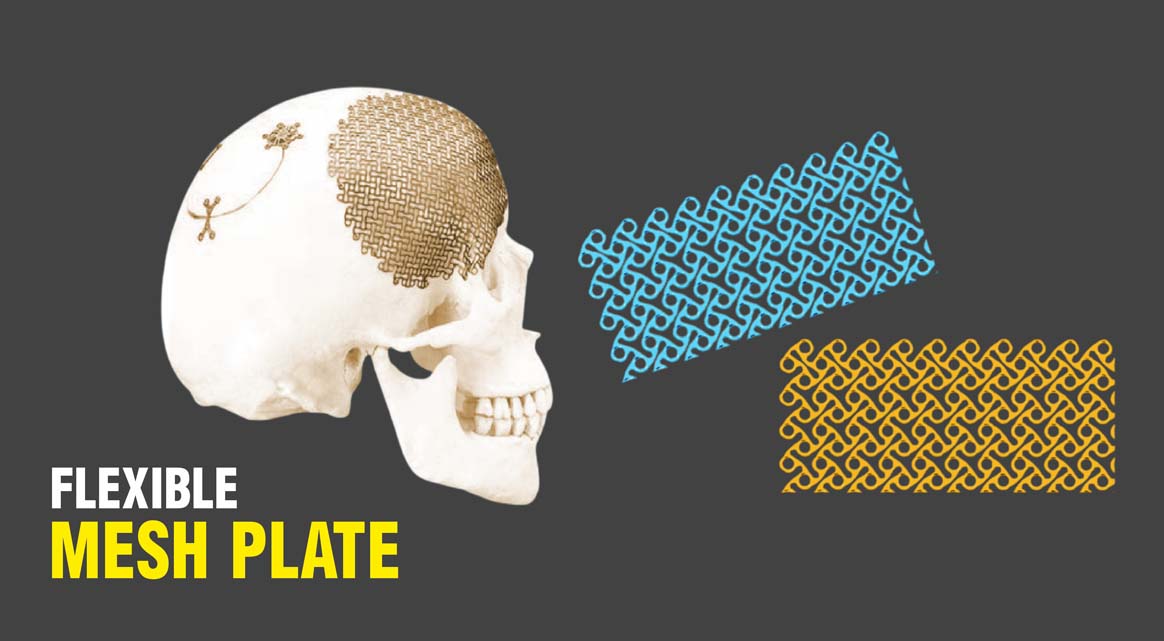
Flexible Mesh Plate is a type of implant used in fracture fixation or reconstructive surgeries, particularly in areas where standard rigid plates may not conform well to the bone’s natural shape or where custom shaping is required.
Key Features of Flexible Mesh Plate
Mesh (Grid) Structure
- Design: The plate consists of a lattice-like structure with multiple small holes or openings.
- Purpose: Allows custom shaping and adaptation to complex anatomical surfaces, such as the contours of the face, skull, or pelvis.
- Benefits: Provides a scaffold that can be cut, bent, or trimmed intraoperatively without compromising the structural integrity.
Flexibility & Contourability
- Material flexibility: Unlike rigid plates, mesh plates can be easily contoured to fit curved or irregular bony surfaces.
- Surgical adaptability: Surgeons can bend or twist the plate to match patient-specific anatomy.
- Use case: Especially helpful in craniofacial, pelvic, and small bone surgeries where bones are curved or difficult to access.
Multiple Fixation Points
- Dense hole configuration: The mesh has many holes spaced evenly across the plate.
- Versatile screw placement: This allows freedom in choosing screw locations, which is crucial when bone quality or size varies.
- Stable fixation: Enhances mechanical stability by distributing stress over a broader area.
Low Profile
- Thin construction: Mesh plates are lightweight and low-profile, minimizing tissue irritation and making them ideal for areas with thin soft tissue coverage, like the face or hands.
- Cosmetic benefit: Especially important in aesthetic-sensitive regions like the orbit or zygoma.
Customizability
- Cuttable: Surgeons can trim the mesh to the exact shape needed using standard surgical tools.
- No need for pre-formed plates: Reduces the need to stock multiple sizes or shapes of implants.
Radiolucency or Minimal Interference with Imaging
- When made from titanium, mesh plates cause minimal artifacts in imaging (CT/MRI), which is important for post-op assessment or if used near tumors or nerves.
Biocompatible Material
- Usually made from:
Titanium: Biocompatible, corrosion-resistant, lightweight, and non-magnetic.
Stainless Steel: Sometimes used, especially in trauma cases where cost is a concern.
- Tissue-friendly: Reduces risk of rejection or inflammation.
Allows Bone Regrowth (in some designs)
- Open structure: Some mesh designs encourage bone ingrowth or integration, especially in non-load-bearing reconstructions.
- Biological support: Can act as a scaffold in bone grafting procedures.
Common Uses of flexible mesh plates
Craniofacial and Maxillofacial Surgery
Orbital Floor and Wall Reconstruction
- Indications: Blow-out fractures, trauma, or tumor resection near the eye.
- Why mesh? The orbital floor is thin and curved; mesh allows a custom fit without impinging on the eye or muscles.
- Benefit: Preserves eye movement and orbital volume.
Zygomatic Arch and Maxilla Repairs
- For fractures involving the cheekbone and upper jaw.
- Mesh adapts to the 3D shape of the facial bones.
Frontal Bone and Skull Reconstruction
- Used after trauma, craniotomy, or tumor removal.
- Fills skull defects and can integrate with bone grafts or prosthetics.
Pelvic and Acetabular Fractures
The pelvis is an irregular structure with limited access and bone variation.
Acetabular Reconstruction
- Especially in complex or comminuted fractures, where standard plates don’t conform well.
- Mesh helps bridge bony gaps and support the articular surface.
Pelvic Ring Injuries
- Used when there’s segmental bone loss or deformity.
- Allows multidirectional screw fixation to stabilize multiple bone fragments.
Oncologic Reconstruction
Post-Tumor Resection Defects
- After removing bone tumors in the skull, pelvis, or elsewhere, mesh can rebuild missing bone structure.
- Works as a scaffold for bone grafts or synthetic fillers.
Small Bone Fractures (Hands, Feet)
- Metacarpals and Phalanges
- Mesh plates are helpful in highly comminuted (shattered) hand fractures or crush injuries.
- Provide multiple screw placement options in tiny bones.
Foot and Ankle Reconstructions
- Can be used in complex midfoot or hindfoot injuries where precise shaping is necessary.
Spinal Reconstruction (Selected Cases)
Vertebral Body Replacement or Fusion Support
- Not typically a primary fixation device but may be used as scaffold or support in fusion procedures when major bone loss occurs.
Pediatric Surgery
Bone Stabilization in Growing Children
- Because mesh can be shaped and is less rigid, it’s used in delicate anatomical areas where growth plates must be preserved.
Bone Grafting and Defect Bridging
Used to contain and support bone graft material in cases of:
- Non-unions
- Segmental bone loss
- Revision surgeries
Temporary Fixation or Protection
- Used as a temporary protective cage over sensitive structures (e.g., nerves, dura mater) during staged reconstruction.
Advantages of Flexible Mesh Plates
High Adaptability to Complex Anatomical Shapes
- Mesh plates can be easily contoured to fit irregular or curved bone surfaces—something that’s difficult or impossible with rigid, pre-shaped plates.
- Especially useful in craniofacial, pelvic, and hand surgeries, where the bony anatomy is complex and variable.
- Reduces intraoperative time spent searching for a perfectly shaped plate—one mesh can be customized on the spot.
Multiple Screw Fixation Options
- The mesh’s grid-like structure offers many tiny holes, giving surgeons flexibility in screw placement.
- Critical in comminuted fractures (where the bone is in many pieces) or in bones with varying quality (e.g., osteoporotic bone).
- Allows multidirectional fixation, increasing overall mechanical stability.
Cuttable and Trim-to-Size
Mesh plates can be cut with standard surgical tools, which allows surgeons to:
- Remove unnecessary sections
- Create custom shapes for unique fractures
- Avoid important anatomical structures (e.g., nerves, vessels)
This also minimizes the need for keeping many different implant shapes in stock.
Low Profile and Lightweight
Especially important in areas with thin soft tissue coverage like the face, hands, and feet.
A low-profile plate reduces the risk of:
- Soft tissue irritation
- Implant visibility or palpability
- Need for future implant removal due to discomfort
Minimal Imaging Artifacts
When made of titanium, mesh plates cause minimal interference with imaging (e.g., CT or MRI).
Important for:
- Post-op monitoring
- Oncology follow-ups
- Neurovascular assessments
This ensures high-quality imaging for diagnostics or surgical planning.
Biocompatibility and Safety
Typically made of titanium or surgical-grade stainless steel, which are:
- Corrosion-resistant
- Non-toxic
- Biologically inert
Minimizes the risk of:
- Allergic reaction
- Foreign body response
- Chronic inflammation
Supports Bone Healing and Grafting
- The open mesh design can serve as a scaffold for bone ingrowth or contain bone graft material.
- Encourages osseointegration (direct bone-implant bonding).
Useful in treating:
- Segmental bone loss
- Non-unions
- Post-tumor resection voids
Reduced Inventory Burden
- Instead of needing different shaped plates for different bones and patients, one mesh can serve many purposes.
Helps reduce:
- Cost of stocking multiple implant types
- Surgical preparation time
- Waste from unused, pre-shaped implants
Ideal for Temporary or Staged Fixation
- Can be used as a temporary cage or protective barrier over nerves, brain tissue, or grafts until definitive surgery is done.
- Offers mechanical protection with minimal invasiveness.
Useful in Pediatric Cases
- Its flexibility and customizability make it well-suited to avoid growth plates and adapt to the smaller anatomy of children.
- Less likely to interfere with bone growth compared to bulky, rigid implants.

You must be logged in to post a comment.