

The evolution of fracture fixation has transformed orthopaedic surgery from basic stabilization techniques to highly specialized biomechanical solutions that promote early mobilization and biological healing. Among the most versatile and widely used orthopaedic implants, the Locking Reconstruction Plate Curved occupies a critical position, particularly in the management of complex fractures involving anatomical contours and multi-planar deformities.
Locking reconstruction plates combine the principles of locking plates and anatomical contouring, allowing surgeons to address fractures in regions where conventional plates fail to achieve optimal stability. Their ability to be contoured in three dimensions without compromising screw–plate interface strength makes them indispensable in trauma, reconstructive surgery, and revision procedures.
What Is a Locking Reconstruction Plate Curved?
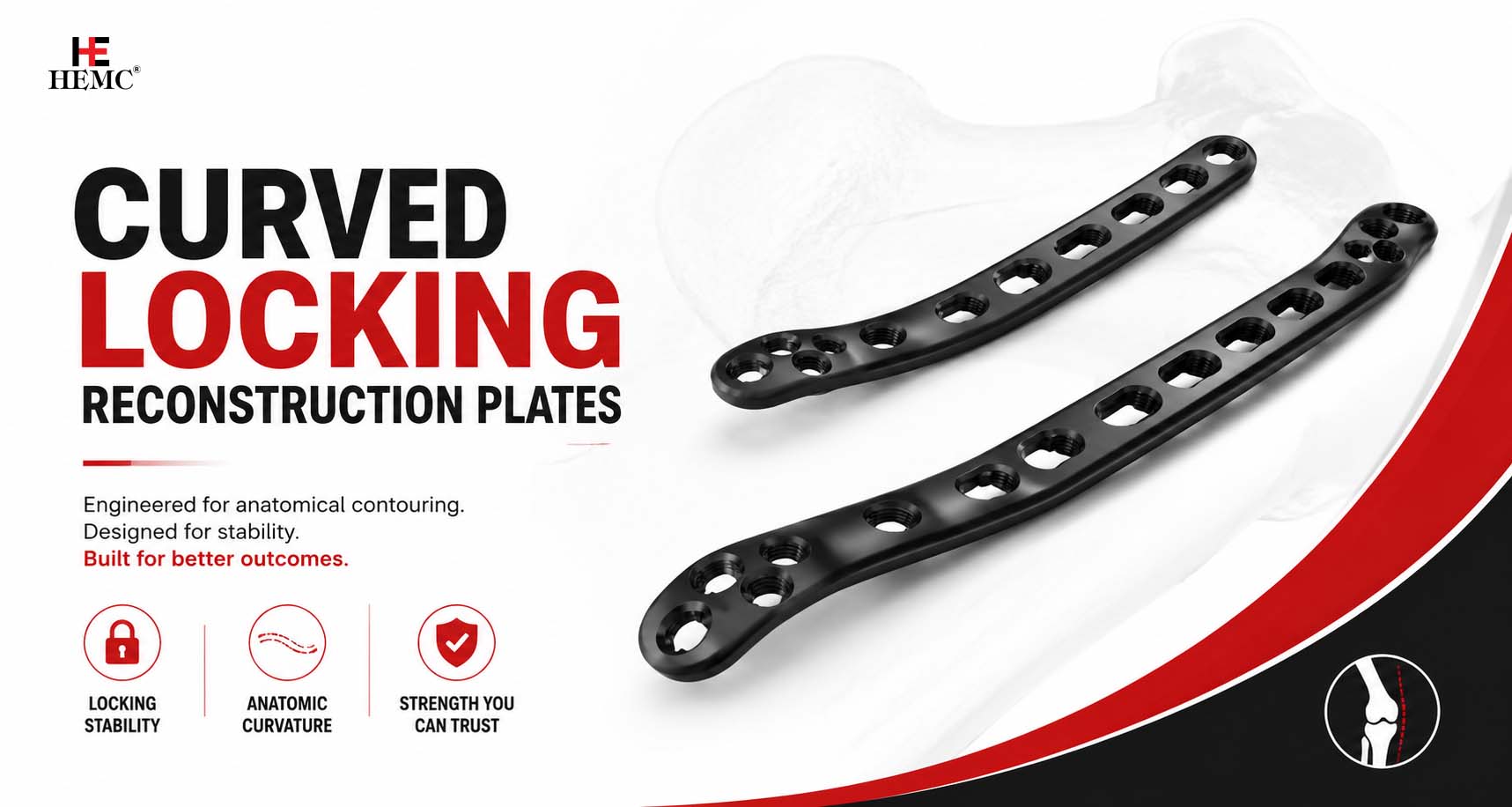
A Locking Reconstruction Plate Curved is a pre-contoured or contourable metallic plate designed with combi-holes or threaded locking holes, allowing the use of both locking screws and conventional cortical screws. The plate is specifically engineered to follow the natural curvature of bones such as the pelvis, clavicle, distal humerus, proximal tibia, acetabulum, and peri-articular regions.
Unlike standard reconstruction plates, locking variants do not rely solely on friction between the plate and bone. Instead, stability is achieved through a fixed-angle construct formed by the threaded interface between the plate and the locking screw.
Design Features and Materials
Anatomical Curvature and Contourability
The defining feature of this implant is its ability to be contoured in multiple planes without losing mechanical strength. This makes it particularly useful in anatomically complex regions where precise plate adaptation is essential.
Locking Plate Technology
- Threaded screw holes
- Fixed-angle stability
- Reduced dependence on plate–bone compression
- Preservation of periosteal blood supply
Material Composition
Locking reconstruction plates are commonly manufactured from:
- Titanium alloy (Ti-6Al-4V) – preferred for its biocompatibility, corrosion resistance, and elasticity
- Stainless steel – offers higher stiffness and cost-effectiveness
These materials are also used extensively in spine implants, hip prosthesis, hip implants, and maxillofacial implants, ensuring compatibility across orthopaedic systems.
Biomechanical Principles
- The biomechanical superiority of locking reconstruction plates lies in their ability to function as internal fixators rather than traditional compression devices.
Fixed-Angle Stability
The locking mechanism prevents screw toggling and pull-out, making the construct highly resistant to:
- Axial loading
- Bending forces
- Torsional stress
This is particularly beneficial in:
- Osteoporotic bone
- Comminuted fractures
- Metaphyseal and peri-articular fractures
Load Distribution
Unlike conventional plates that concentrate stress at screw–bone interfaces, locking plates distribute loads evenly across the construct, reducing implant failure.
Indications and Clinical Applications
Pelvic and Acetabular Fractures
Curved locking reconstruction plates are widely used in pelvic ring injuries and acetabular fractures due to their ability to conform to complex pelvic anatomy.
Clavicle and Scapular Fractures
The S-shaped curvature of the clavicle demands precise contouring, making curved locking reconstruction plates ideal for:
- Midshaft clavicle fractures
- Non-unions and malunions
Distal Humerus and Peri-Articular Fractures
When combined with locking screws, these plates provide angular stability in fractures involving:
- Distal humerus
- Proximal ulna
- Tibial plateau
Osteoporotic Fractures
In elderly patients, where bone quality is compromised, locking constructs outperform conventional plating by reducing screw loosening and fixation failure.
Revision and Complex Trauma
In revision surgeries, particularly following failure of interlocking nails or conventional plates, locking reconstruction plates offer reliable salvage fixation.
Comparison with Other Orthopaedic Fixation Systems
Locking Plates vs Interlocking Nails
- Interlocking nails are ideal for diaphyseal fractures
- Locking reconstruction plates excel in:
- Metaphyseal regions
- Peri-articular fractures
- Irregular bone surfaces
Both systems complement each other in modern trauma care.
Relationship with Spine Implants
The same locking principles used in reconstruction plates are applied in spine implants, such as pedicle screw–rod systems, where angular stability and load sharing are critical.
Role Alongside Hip Implants and Hip Prosthesis
In periprosthetic fractures around a hip prosthesis, curved locking reconstruction plates are often used in combination with cerclage wires or cables to stabilize the femur without disturbing the implant.
Maxillofacial Implants
Miniaturized locking reconstruction plates have also found applications in maxillofacial implants, particularly in mandibular and mid-face reconstruction, demonstrating the versatility of locking plate technology.
Surgical Technique Considerations
Preoperative Planning
- Accurate fracture assessment using CT scans
- Selection of plate length and curvature
- Determination of screw type (locking vs cortical)
Plate Contouring
Although locking plates tolerate contouring, excessive bending at screw holes should be avoided to preserve the integrity of the locking threads.
Screw Insertion
- Locking screws must be inserted perpendicular to the plate
- Torque-limiting screwdrivers are recommended
- Combination fixation improves fracture compression and stability
Advantages of Locking Reconstruction Plate Curved
- Enhanced fixation in poor bone quality
- Reduced risk of screw loosening
- Preservation of blood supply
- Improved fracture healing
- Versatility across anatomical regions
- Compatibility with modern orthopaedic implants
Limitations and Complications
Despite their advantages, locking reconstruction plates are not without limitations:
- Higher cost compared to conventional plates
- Risk of overly rigid fixation if misused
- Technical demands during screw insertion
- Difficulty in plate removal due to cold welding (rare)
- Proper surgical technique and patient selection remain essential.
Future Developments and Innovations
The future of locking reconstruction plates is closely tied to advancements in:
- Patient-specific implants
- 3D-printed anatomical plates
- Hybrid systems integrating plates and interlocking nails
- Smart implants with load-sensing capabilities
These innovations mirror progress seen in spine implants, hip implants, and maxillofacial implants, reinforcing the interconnected evolution of orthopaedic technology.
Conclusion
The Locking Reconstruction Plate Curved represents a cornerstone of contemporary fracture fixation. By combining anatomical adaptability with fixed-angle stability, it addresses the challenges posed by complex fractures, osteoporotic bone, and irregular skeletal anatomy.
Its role alongside locking plates, locking screws, interlocking nails, spine implants, hip prosthesis, hip implants, and maxillofacial implants highlights its versatility and importance in comprehensive musculoskeletal care. When used judiciously, locking reconstruction plates significantly enhance surgical outcomes, promote biological healing, and support early functional recovery.
As orthopaedic science continues to advance, the locking reconstruction plate will remain a trusted and evolving solution in the surgeon’s armamentarium.