

Advances in fracture fixation have steadily shifted orthopaedic practice toward implants that provide reliable stability while respecting the biology of bone healing. Among contemporary orthopaedic implants, the Secure Locking Tubular Plate represents a refined evolution of traditional tubular plating systems, integrating locking technology with a low-profile, anatomically adaptable design.
Secure locking tubular plates are particularly valued for fractures of small bones and peri-articular regions, where soft-tissue preservation, precise fixation, and angular stability are critical. By combining the principles of locking plates and locking screws, these implants offer superior fixation compared to conventional tubular plates, especially in osteoporotic bone and comminuted fracture patterns.
Understanding the Secure Locking Tubular Plate
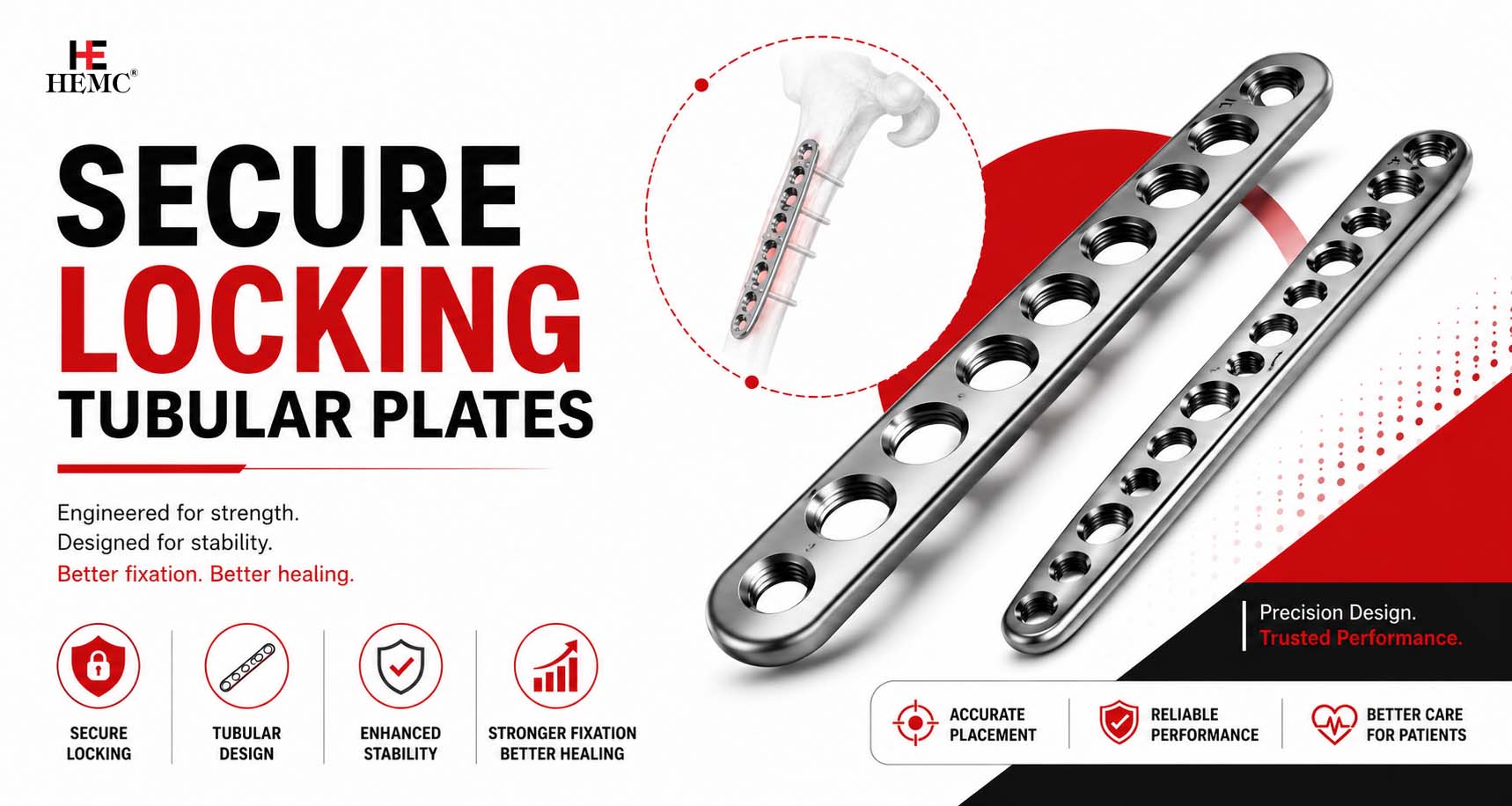
A Secure Locking Tubular Plate is a low-profile plate, typically semi-circular or tubular in cross-section, designed with threaded holes that accept locking screws. Unlike traditional one-third or one-quarter tubular plates that rely on friction between the plate and bone, the secure locking tubular plate functions as a fixed-angle internal fixator.
This design allows stable fixation even when the plate is not compressed tightly against the bone surface, thereby preserving periosteal blood supply and reducing soft tissue trauma.
Design Features and Material Composition
Low-Profile Tubular Geometry
The tubular design ensures:
- Minimal soft tissue irritation
- Reduced prominence under thin skin
- Applicability in anatomically constrained regions such as the ankle, wrist, forearm, and clavicle
Locking Plate Technology
Key features include:
- Threaded holes compatible with locking screws
- Fixed-angle screw–plate interface
- Option for combination holes allowing both locking and non-locking screws
- This design philosophy is shared across many locking plates, spine implants, and modern maxillofacial implants.
Materials Used
Secure locking tubular plates are commonly manufactured from:
- Titanium alloy (Ti-6Al-4V) for biocompatibility, elasticity, and corrosion resistance
- Stainless steel for higher stiffness and cost efficiency
- These materials are also widely used in hip implants, hip prosthesis, and interlocking nails, ensuring material compatibility within orthopaedic systems.
Biomechanical Principles
Fixed-Angle Stability
The locking screw threads engage directly with the plate, creating a rigid construct that resists:
- Screw loosening
- Angular collapse
- Torsional forces
This is especially important in osteoporotic bone, where traditional screws may fail to achieve adequate purchase.
Internal Fixator Concept
Unlike conventional plates, the secure locking tubular plate does not rely on plate-to-bone compression. This minimizes disruption of the periosteal blood supply and promotes biological fracture healing, a principle also central to modern spine implants and bridge plating techniques.
Load Distribution
The construct distributes mechanical load across the plate–screw system rather than concentrating stress at individual screw–bone interfaces, reducing the risk of implant failure.
Indications and Clinical Applications
Ankle and Distal Tibia Fractures
Secure locking tubular plates are frequently used in:
- Medial and lateral malleolar fractures
- Distal tibial fractures with poor bone quality
- Osteoporotic ankle fractures
- The low-profile design minimizes soft tissue irritation in regions with limited coverage.
Forearm and Wrist Fractures
In fractures of the ulna, radius, and distal forearm, locking tubular plates provide:
- Precise alignment
- Stable fixation for early mobilization
- Reduced risk of secondary displacement
Clavicle and Small Bone Fixation
The plate’s contourability makes it suitable for:
- Midshaft clavicle fractures
- Metacarpal and metatarsal fractures
- Selected pediatric and adolescent fractures
Osteoporotic and Fragility Fractures
In elderly patients, secure locking tubular plates outperform conventional tubular plates by providing angular stability even when bone purchase is compromised.
Adjunct Fixation in Complex Trauma
In complex injuries treated primarily with interlocking nails, locking tubular plates may be used as adjuncts for:
- Peri-articular extensions
- Additional fragment stabilization
- Neutralization of rotational forces
Comparison with Other Fixation Systems
Locking Tubular Plates vs Conventional Tubular Plates
- Conventional plates rely on compression and friction
- Secure locking tubular plates provide fixed-angle stability
- Locking constructs reduce screw pull-out and loosening
Relationship with Interlocking Nails
Interlocking nails remain the gold standard for diaphyseal fractures, while secure locking tubular plates excel in:
- Metaphyseal and peri-articular regions
- Small bone and anatomically constrained areas
- Situations requiring low-profile implants
Parallels with Spine Implants
The fixed-angle principle of locking tubular plates mirrors that of spine implants, such as pedicle screw–rod systems, where angular stability and load sharing are essential.
Use Around Hip Implants and Hip Prosthesis
In selected cases of periprosthetic fractures around a hip prosthesis, small locking plates may be used as supplementary fixation in combination with cables or longer plates.
Applications in Maxillofacial Implants
Miniaturized locking tubular plate designs have influenced maxillofacial implants, particularly in mandibular and facial fracture fixation, where precision and stability are paramount.
Surgical Technique Considerations
Preoperative Planning
- Thorough fracture assessment with X-ray and CT when needed
- Selection of appropriate plate length and screw configuration
- Planning for combination fixation using locking and cortical screws
Plate Application
- Anatomical contouring should be gentle to avoid damaging locking threads
- Plate does not need to be compressed against the bone surface
- Accurate positioning is essential for optimal screw trajectory
Screw Insertion
- Locking screws must be inserted perpendicular to the plate
- Torque-limiting devices are recommended
- Combination of locking and non-locking screws can enhance construct versatility
Advantages of Secure Locking Tubular Plates
- Angular stability in poor bone quality
- Low-profile design with minimal soft tissue irritation
- Reduced risk of screw loosening
- Preservation of periosteal blood supply
- Early mobilization and functional recovery
- Compatibility with modern orthopaedic implants
Limitations and Potential Complications
Despite their advantages, secure locking tubular plates have limitations:
- Higher cost compared to conventional tubular plates
- Risk of overly rigid fixation if used indiscriminately
- Technical demands during accurate screw insertion
- Potential difficulty in implant removal in rare cases
These risks can be minimized through proper surgical technique and appropriate patient selection.
Role in the Future of Orthopaedic Implant Technology
The secure locking tubular plate reflects broader trends in orthopaedic innovation, including:
- Hybrid fixation strategies combining plates and interlocking nails
- Patient-specific and anatomically contoured implants
- Improved surface coatings for better osseointegration
These developments parallel advances seen in spine implants, hip implants, hip prosthesis, and maxillofacial implants, underscoring the integrated evolution of musculoskeletal technology.
Conclusion
The Secure Locking Tubular Plate is a highly effective solution for fracture fixation in anatomically delicate regions and compromised bone quality. By merging the low-profile benefits of traditional tubular plates with the biomechanical advantages of locking plates and locking screws, it provides reliable, biologically friendly fixation across a wide range of clinical scenarios.
Its complementary role alongside interlocking nails, spine implants, hip prosthesis, hip implants, and maxillofacial implants highlights its importance in modern orthopaedic practice. When applied thoughtfully, secure locking tubular plates enhance stability, promote fracture healing, and contribute to predictable, patient-centered outcomes in trauma and reconstructive surgery.