


A cable plating system is an advanced orthopedic fixation technique that combines cables and plates to stabilize fractures, particularly in challenging cases such as periprosthetic fractures, comminuted fractures, and osteoporotic bone conditions. This system is particularly useful when traditional screw fixation alone may not be sufficient due to poor bone quality or complex fracture patterns.
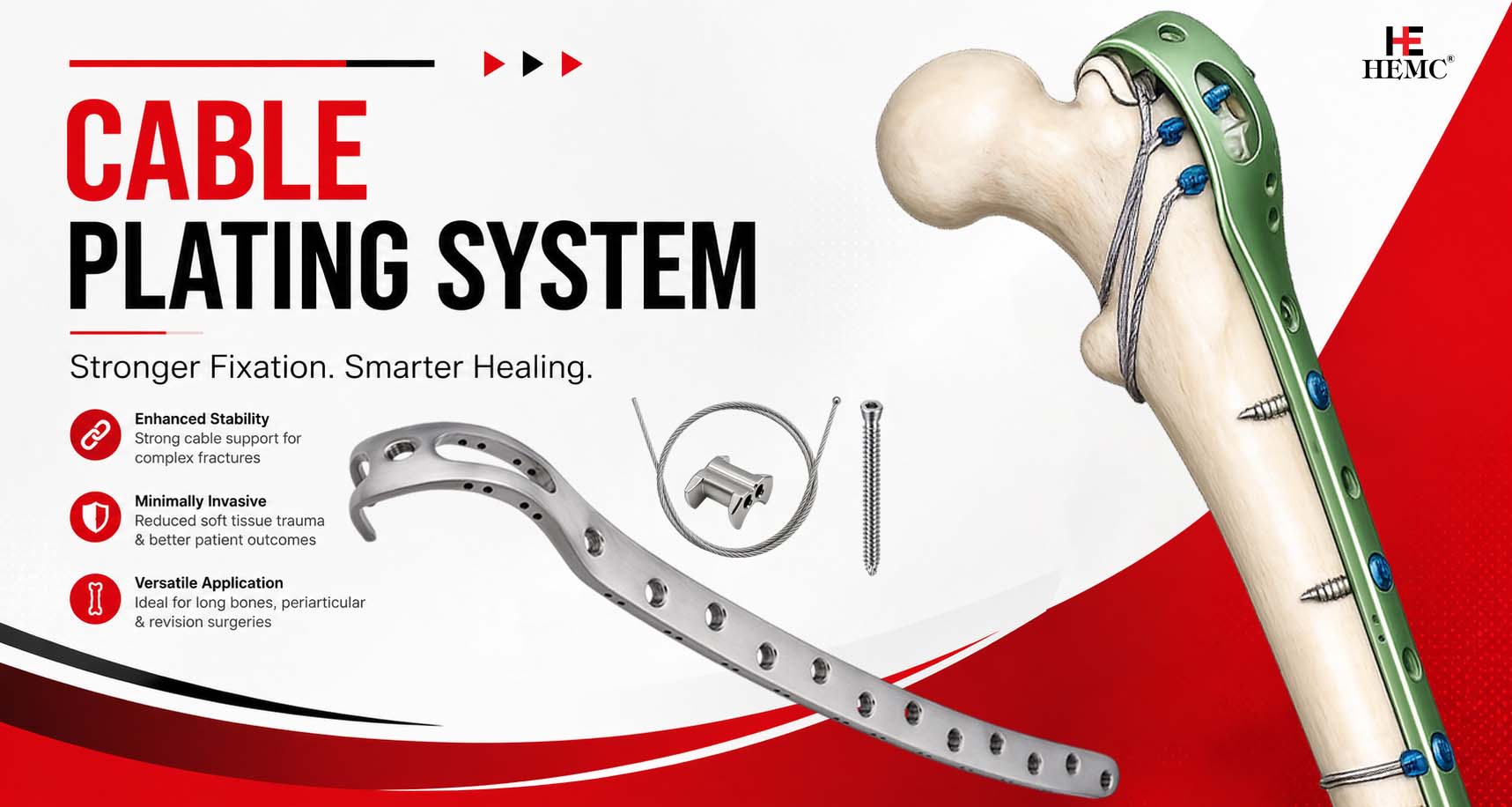
Components of a Cable Plating System
A cable plating system consists of several key elements, each designed to optimize fracture fixation and healing:
Cables
Material:
- Stainless steel or titanium (biocompatible and corrosion-resistant).
Diameter:
- Ranges from 1.3mm to 2.0mm, depending on the system and bone size.
Structure:
- Multi-stranded for flexibility and enhanced load distribution.
Function:
- Encircles the bone, providing circumferential stability.
- Helps in fracture compression and alignment.
- Reduces the risk of bone fragment displacement.
Plates
These are metallic plates designed to work in conjunction with cables for enhanced fracture stabilization.
Material:
- Titanium or stainless steel for durability and osseointegration.
Design Features:
- Cable holes or slots – Allow cables to pass through and lock into place.
- Screw holes – Enable additional screw fixation for rigid stability.
- Pre-contoured or bendable plates – Fit different anatomical locations.
- Variable thickness (3mm–5mm) – Depends on bone and load-bearing needs.
Types:
- Standard cable plates – Used for long bones (femur, humerus, etc.).
- Periprosthetic plates – Designed for fractures around joint prostheses.
- Reconstruction plates – For complex fracture patterns.
Tensioning Device
A cable tensioner is used to apply controlled tension to the cable before securing it.
Types:
- Manual tensioners – Hand-operated with a ratchet mechanism.
- Power-assisted tensioners – Provide precise, consistent tensioning.
Function:
- Ensures proper compression of the fracture.
- Prevents excessive tightening, reducing the risk of bone damage.
Crimping or Locking Mechanism
Once the cable is tensioned, it must be securely locked in place.
Types:
- Crimping Sleeves (Ferrules) – Metal sleeves that are compressed to lock cables.
- Integrated Locking Systems – Some plates have built-in locking features.
- Screw Locking Mechanisms – Used to secure cables directly within the plate.
Function:
- Prevents cable loosening over time.
- Ensures long-term stability of the fixation construct.
Cable Cutters
After securing the cables, excess length needs to be trimmed.
Types:
- Heavy-duty cutters – Designed for stainless steel or titanium cables.
- Flush cutters – Provide a smooth cut, preventing soft tissue irritation.
Function:
- Reduces the risk of soft tissue damage from excess cable ends.
Additional Fixation Screws
Used in conjunction with cables to enhance overall stability.
Types:
- Cortical screws – Provide bicortical fixation for stronger stability.
- Locking screws – Useful in osteoporotic bone where conventional screws may fail.
- Polyaxial screws – Allow for angled screw placement, improving fixation.
Function:
- Increases rigid fixation when combined with cable constructs.
Indications for a Cable Plating System
The cable plating system is primarily used in cases where traditional screw fixation alone is inadequate. Key indications include:
Periprosthetic Fractures
- Fractures around joint prostheses (hip, knee, shoulder).
- Plates and cables help stabilize fractures without compromising implant stability.
Long Bone Fractures
- Femur, humerus, tibia fractures where additional stability is needed.
- Useful in osteoporotic patients where screws may loosen over time.
Comminuted Fractures
- Multi-fragmentary fractures where standard plating alone is not sufficient.
- Cables help provide circumferential support, reducing fragment displacement.
Spiral and Oblique Fractures
- Cables can act as interfragmentary fixation, ensuring optimal bone alignment.
Revision Surgery and Bone Reconstruction
- Infected or non-union fractures where standard hardware may be insufficient.
- Used in tumor resection and complex reconstructions.
Disadvantages and Potential Complications
While highly effective, the cable plating system does have some potential drawbacks:
Soft Tissue Irritation
- Improperly trimmed or poorly placed cables can cause irritation to surrounding muscles.
Cable Fracture or Loosening
- Excessive tensioning can lead to cable failure.
- Inadequate crimping can result in gradual cable loosening.
Osteolysis (Bone Resorption)
- Chronic motion of cables against the bone can cause bone loss over time.
Technical Challenges
- Requires experience and precision to ensure proper tensioning and placement.
Surgical Technique Overview
Step 1: Fracture Exposure and Preparation
- A minimally invasive approach is used when possible.
- Fracture fragments are aligned and reduced.
Step 2: Cable Placement and Tensioning
- Cables are passed around the bone and positioned through the plate slots.
- Tensioning device is used to apply the correct force.
Step 3: Crimping and Locking
- Once tensioned, the cable is crimped or locked to secure it.
Step 4: Plate Fixation with Screws
- Additional screws are placed for enhanced stability.
Step 5: Closure and Postoperative Care
- Soft tissues are carefully closed to minimize irritation.
- Rehabilitation plan is initiated to promote healing.
Conclusion
The cable plating system is a powerful orthopedic tool, particularly in periprosthetic fractures, osteoporotic bone, and complex reconstructions. By integrating cables with plates and screws, it offers enhanced stability, biomechanical strength, and versatility in fracture management. However, it requires proper technique to avoid complications such as soft tissue irritation and cable loosening.

You must be logged in to post a comment.