


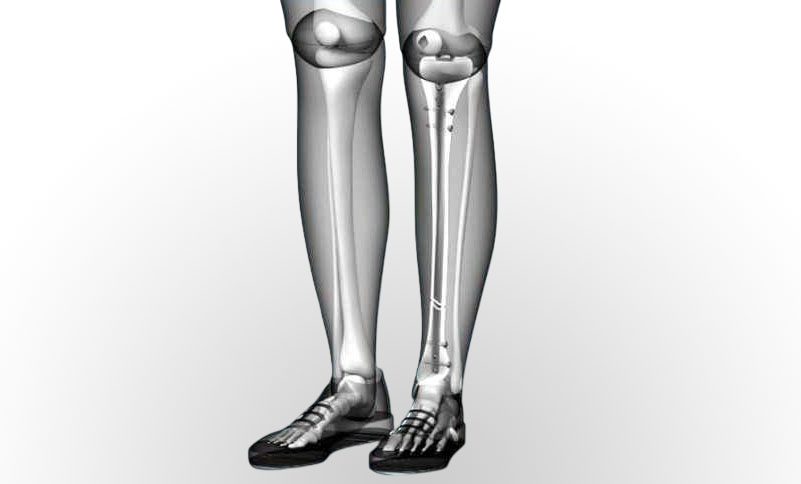
Interlocking nails and intramedullary (IM) nails are both used for the internal fixation of long bone fractures, but they have key differences in their design, function, and application. Let’s break them down in detail.
Intramedullary (IM) Nail
An intramedullary nail is a metal rod inserted into the medullary (central) canal of a long bone to provide stability and alignment during fracture healing. It works by sharing the load between the bone and the implant, promoting early weight-bearing.
Key Features:
- Inserted into the medullary canal of the bone.
- Provides axial stability but may allow some rotational movement.
- Primarily used for simple fractures where additional fixation isn’t needed.
- Relies on press-fit fixation (without screws) in some cases.
Advantages:
- Minimally invasive compared to plating.
- Provides load-sharing rather than load-bearing, reducing stress shielding.
- Promotes early mobilization in some cases.
- Smaller incisions and reduced soft tissue damage.
Disadvantages:
- May not provide adequate rotational or axial stability for complex fractures.
- Can allow some degree of shortening or rotation if not properly stabilized.
- Not ideal for comminuted (multiple fragment) fractures without locking.
Interlocking Nail
An interlocking nail is a specialized type of intramedullary nail that includes proximal and distal locking screws to enhance stability. It is used for fractures that need additional fixation to prevent rotation and shortening.
Key Features:
- A type of intramedullary nail with additional screw fixation.
- Has holes for locking screws at both ends.
- Provides better stability for comminuted, segmental, or unstable fractures.
- Prevents rotation, shortening, and shear movements.
Advantages:
- More stable than a standard IM nail.
- Suitable for complex fractures, including comminuted, segmental, and unstable fractures.
- Prevents bone shortening and rotation.
- Allows for early weight-bearing in some cases.
Disadvantages:
- More technically demanding to insert.
- Additional surgical steps required for inserting locking screws.
- Slightly increased operative time.
Comparison Table:
| Feature | Intramedullary Nail | Interlocking Nail |
| Fixation | Inside the medullary canal, no screws | Inside the medullary canal, with locking screws |
| Rotational Stability | Limited | High (prevents rotation) |
| Axial Stability | Moderate | High (prevents shortening) |
| Indications | Simple fractures | Complex, comminuted, or unstable fractures |
| Weight Bearing | May allow early weight-bearing | More controlled weight-bearing |
| Surgical Complexity | Easier | More challenging due to locking screws |
Which One to Choose?
- For simple fractures → Standard IM nail may be sufficient.
- For comminuted, segmental, or unstable fractures → Interlocking nail is preferred.
- For fractures at high risk of displacement or rotation → Interlocking nail provides better stability.
Roles of Intramedullary and Interlocking Nails in Orthopedic Surgeries
Both intramedullary (IM) nails and interlocking nails play a crucial role in orthopaedic surgeries, especially in the treatment of long bone fractures. Their primary function is to stabilize broken bones and facilitate proper healing while allowing early mobilization. Below are their specific roles in various orthopaedic procedures:
Stabilization of Long Bone Fractures
One of the most common applications of IM and interlocking nails is in the fixation of long bone fractures, including the femur, tibia, and humerus.
- Intramedullary nails provide internal support within the bone’s medullary canal.
- Interlocking nails add extra stability with locking screws, preventing bone displacement.
Example: A closed femoral shaft fracture treated with an interlocking nail prevents shortening and rotation while allowing early weight-bearing.
Load Sharing and Early Mobilization
Unlike plates and external fixators that bear most of the load, IM and interlocking nails act as load-sharing devices. This helps in:
- Reducing stress shielding.
- Allowing partial weight-bearing earlier.
- Promoting faster bone remodeling.
Example: A tibial fracture fixed with an interlocking nail allows a patient to begin walking sooner than with external fixation.
Treatment of Complex and Comminuted Fractures
- Interlocking nails are especially useful for comminuted fractures (fractures with multiple bone fragments) because they prevent bone shortening and rotation.
- They are also useful in segmental fractures, where a section of bone is completely separated.
Example: A segmental tibial fracture can be treated with an interlocking nail to keep all bone fragments aligned during healing.
Pathological Fracture Management
IM and interlocking nails are used for pathological fractures (caused by bone-weakening conditions like osteoporosis or tumors). They provide internal support and reduce pain.
Example: A femoral shaft fracture due to metastasis can be stabilized with an intramedullary nail to improve function and reduce pain.
Nonunion and Malunion Correction
- In cases where a fracture fails to heal properly (nonunion) or heals incorrectly (malunion), interlocking nails can be used to stabilize the bone after realignment.
- Sometimes, nails are combined with bone grafting to stimulate healing.
Example: A tibial nonunion is treated by reaming the medullary canal and inserting an interlocking nail to improve stability and bone healing.
Open Fracture and Polytrauma Management
- In open fractures, where bones are exposed due to severe trauma, IM and interlocking nails provide a stable internal fixation.
- In polytrauma cases (multiple injuries), these nails help with damage control orthopedic surgery (DCO) by providing temporary stabilization.
Example: A patient with multiple injuries, including a femoral fracture, can be stabilized quickly with an interlocking nail, allowing focus on life-threatening conditions first.
Pediatric and Geriatric Fracture Treatment
- Flexible IM nails (such as Titanium Elastic Nails, TENs) are used in children, as they allow some bone movement, which promotes natural healing.
- In elderly patients, interlocking nails are used to prevent bone collapse in osteoporotic fractures.
Example: A pediatric femoral fracture is treated with a flexible IM nail to allow continued bone growth.
Limb Lengthening and Deformity Correction
Specialized IM nails (e.g., magnetically controlled nails) are used in limb lengthening procedures or correction of bone deformities.
Example: An orthopedic surgeon may use an intramedullary lengthening nail to gradually extend a short femur in a patient with limb length discrepancy.
Post-Traumatic Reconstruction
In cases where previous trauma has caused bone loss, deformity, or instability, interlocking nails help reconstruct and restore function.
Example: A patient with post-traumatic femoral shortening may require an interlocking nail with bone grafting.
Conclusion:
Intramedullary and Interlocking Nails Play Critical Roles in:
✔ Fixing long bone fractures (femur, tibia, humerus, etc.).
✔ Allowing early mobilization and weight-bearing.
✔ Stabilizing complex, comminuted, and segmental fractures.
✔ Preventing rotational instability and bone shortening.
✔ Aiding in nonunion and malunion correction.
✔ Managing pathological fractures and osteoporotic bones.
✔ Helping in trauma cases, pediatric care, and post-surgical reconstruction.

You must be logged in to post a comment.