

Advancements in trauma and reconstructive surgery have transformed the field of orthopaedics, leading to the development of highly specialized fixation systems. Among these innovations, the Cable Plating System has emerged as an effective and versatile solution for managing complex fractures, periprosthetic fractures, osteoporotic bone conditions, and revision surgeries. Designed to provide enhanced stability and reliable fixation, cable plating systems are widely used in modern orthopaedic procedures.
As the demand for high-quality orthopaedic implants continues to increase, surgeons are seeking fixation devices that offer superior biomechanical performance while preserving bone integrity. The Cable Plating System combines the advantages of metallic cables and plates, enabling surgeons to achieve stable fixation in situations where conventional methods may not be sufficient. When used alongside locking plates and screws, cerclage cables, and advanced general instruments, these systems contribute significantly to improved patient outcomes and faster rehabilitation.
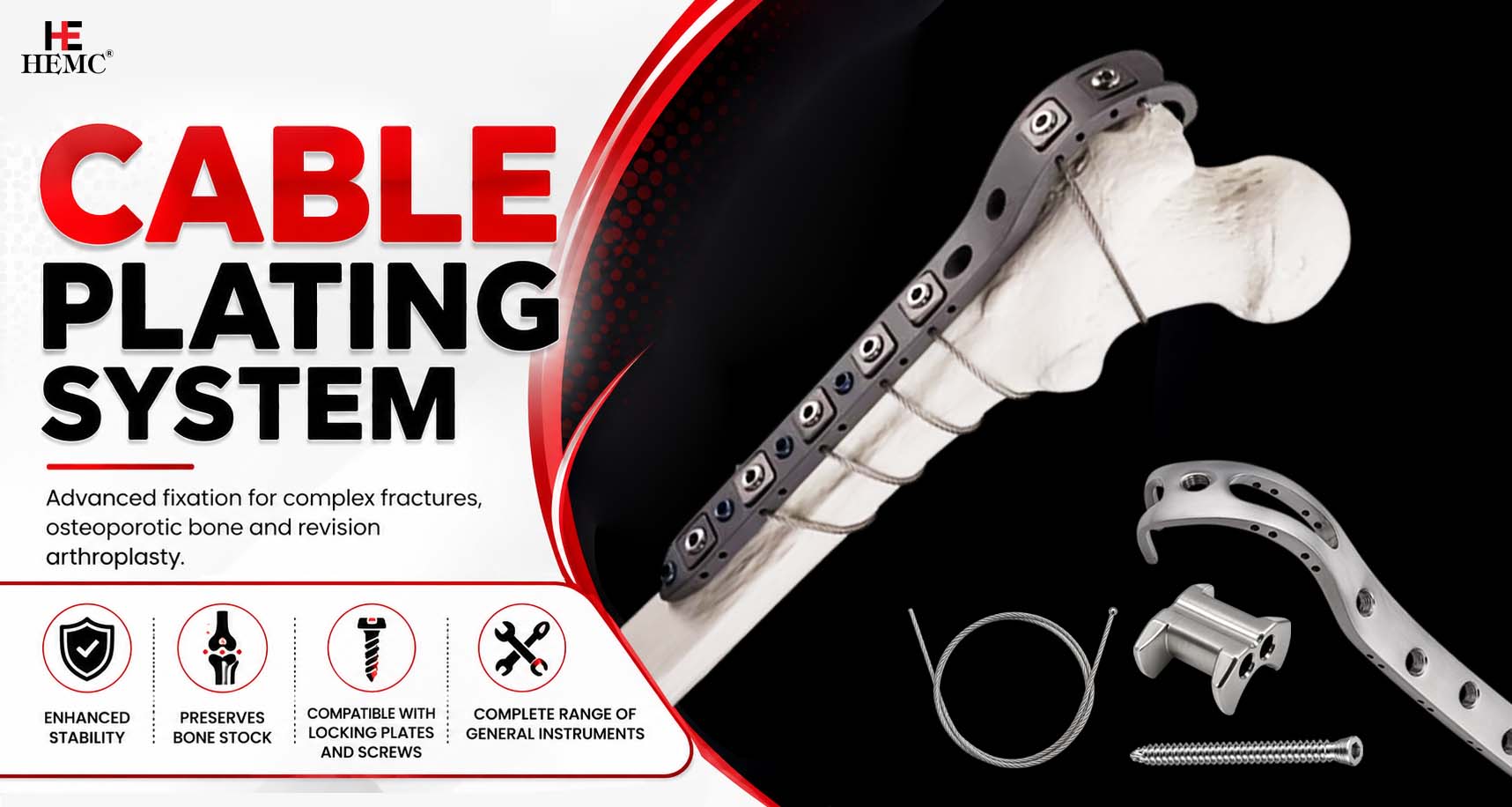
Understanding the Cable Plating System
A Cable Plating System is an internal fixation device specifically designed to stabilize fractures and support bone healing. It incorporates metallic cables and specially engineered plates that work together to provide circumferential compression and rigid fixation around fractured bone segments.
Unlike conventional plating systems that rely solely on screws, cable plating systems allow surgeons to secure implants around the bone without extensive disruption of soft tissues. This makes them particularly useful in cases involving:
- Periprosthetic fractures
- Osteoporotic bones
- Revision arthroplasty
- Comminuted fractures
- Long bone fractures
- Complex trauma cases
These systems are often used in conjunction with locking plates and screws, creating a hybrid fixation approach that enhances mechanical stability.
Importance of Cable Plating Systems in Orthopaedic Surgery
Modern orthopaedic surgery focuses on achieving stable fixation while preserving blood supply and minimizing soft tissue damage. The Cable Plating System addresses these goals effectively by providing:
- Excellent fracture stabilization.
- Circumferential fixation around irregular bone surfaces.
- Reduced need for extensive bone exposure.
- Improved resistance to rotational forces.
- Enhanced support for weakened or osteoporotic bone.
Because of these characteristics, cable plating systems have become an integral component of advanced orthopaedic implants used in trauma and revision procedures.
Components of a Cable Plating System
A typical Cable Plating System consists of several components designed to function together efficiently.
Cable Plates
Cable plates are specially manufactured metallic plates that contain holes and slots to accommodate cerclage cables and screws. They provide longitudinal support and distribute forces evenly across the fracture site.
Common materials include:
- Stainless Steel
- Titanium alloys
These materials offer:
- Corrosion resistance
- High tensile strength
- Biocompatibility
- Long-term durability
Cerclage Cables
Cerclage cables are flexible metallic wires that wrap around the bone to provide compression and stability. They are capable of resisting high tensile loads and are particularly useful in osteoporotic bones where screw purchase may be compromised.
Benefits include:
- Strong fixation
- Minimal bone disruption
- Adaptability to irregular anatomy
- Enhanced compression around fracture fragments
Locking Plates and Screws
Modern cable plating systems are frequently combined with locking plates and screws to create a stronger construct.
Locking technology offers:
- Angular stability
- Improved fixation in poor-quality bone
- Reduced risk of screw loosening
- Better load distribution
The combination of cables and locking screws enables surgeons to achieve optimal fixation even in challenging clinical situations.
General Instruments
Successful implantation requires a comprehensive range of general instruments, including:
- Cable tensioners
- Crimping devices
- Wire passers
- Plate benders
- Screwdrivers
- Drill guides
- Reduction forceps
- Torque-limiting instruments
These specialized instruments ensure accurate cable tensioning and proper implant placement during surgery.
Materials Used in Cable Plating Systems
Stainless Steel
Stainless steel remains one of the most widely used materials in orthopaedic implants due to its:
- High strength
- Durability
- Corrosion resistance
- Cost-effectiveness
Titanium Alloy
Titanium provides several advantages:
- Lightweight construction
- Superior biocompatibility
- Excellent fatigue resistance
- Reduced imaging artifacts
The choice of material depends on patient requirements and surgeon preference.
Clinical Applications
Periprosthetic Fractures
Periprosthetic fractures occurring around hip or knee prostheses represent one of the most common indications for Cable Plating Systems.
These fractures are difficult to manage because:
- Bone quality is often compromised.
- Presence of prosthetic stems limits screw placement.
- Conventional fixation may not provide adequate stability.
Cable plating offers effective circumferential fixation around implants while preserving surrounding tissues.
Revision Arthroplasty
Revision surgeries frequently involve:
- Bone loss
- Osteolysis
- Fragile bone stock
Cable plates provide additional support during revision procedures and help maintain implant stability.
Osteoporotic Fractures
Patients with osteoporosis present unique challenges because weak bone cannot always securely hold conventional screws.
By combining cerclage cables with locking plates and screws, surgeons can achieve stronger fixation and minimize the risk of fixation failure.
Complex Femoral Fractures
Cable plating systems are extensively used for:
- Femoral shaft fractures
- Distal femur fractures
- Subtrochanteric fractures
The system helps restore alignment while resisting rotational and bending forces.
Trauma Surgery
Severe trauma often results in comminuted fractures involving multiple fragments. Cable plating systems provide supplemental fixation and improve construct stability in such cases.
Advantages of Cable Plating Systems
Superior Stability
- Cable constructs provide strong circumferential compression and resist rotational forces effectively.
Preservation of Blood Supply
- Minimal periosteal stripping helps preserve vascularity, promoting faster bone healing.
Versatility
The system can be used in combination with:
- Locking plates
- Conventional plates
- Intramedullary nails
- Arthroplasty implants
Reduced Soft Tissue Damage
- Cable placement requires less extensive dissection, minimizing trauma to surrounding tissues.
Effective in Osteoporotic Bone
- Cable fixation provides additional support where screw fixation alone may be insufficient.
Enhanced Fracture Healing
Stable fixation contributes to:
- Early mobilization
- Reduced complications
- Faster rehabilitation
Surgical Technique
Successful surgery begins with careful evaluation of:
- Fracture pattern
- Bone quality
- Implant selection
- Patient anatomy
Radiographic imaging assists surgeons in choosing appropriate orthopaedic implants and fixation strategies.
Fracture Reduction
- Bone fragments are anatomically aligned to restore normal structure.
Plate Positioning
- The cable plate is placed along the bone surface while preserving surrounding soft tissues.
Cable Application
- Cerclage cables are passed around the bone and tensioned using specialized general instruments.
Screw Fixation
- Additional fixation is achieved using locking plates and screws, providing angular stability and stronger mechanical support.
Final Assessment
- Radiographic confirmation ensures proper implant positioning and fracture reduction.
Role of Locking Plates and Screws in Cable Plating Systems
The integration of locking plates and screws has significantly improved fracture fixation techniques.
Their benefits include:
- Fixed-angle stability
- Reduced screw loosening
- Better load sharing
- Enhanced performance in osteoporotic bone
- Increased construct strength
Hybrid constructs consisting of cable plates and locking screws are now widely preferred in complex fracture management.
Future Developments in Orthopaedic Implants
Technological advancements continue to improve the performance of orthopaedic implants.
Future innovations may include:
Patient-Specific Implants
- Customized cable plates designed using 3D imaging and additive manufacturing.
Advanced Biomaterials
- Development of lighter and stronger materials with improved biocompatibility.
Smart Implants
- Sensors integrated into implants to monitor healing and detect complications.
Improved Instrumentation
- Next-generation general instruments that simplify surgical procedures and enhance precision.
Minimally Invasive Techniques
- Smaller incisions and reduced tissue disruption will further improve patient recovery.
Quality Standards and Manufacturing
Manufacturers of orthopaedic implants follow stringent quality standards to ensure product safety and reliability.
Important standards include:
ISO 13485
ASTM specifications
CE certification
FDA regulations
Good Manufacturing Practices (GMP)
These standards guarantee that Cable Plating Systems meet the highest requirements for clinical performance and patient safety.
Conclusion
The Cable Plating System represents a valuable advancement in modern fracture management and reconstructive orthopaedics. Its ability to provide strong circumferential fixation, preserve bone vascularity, and support complex fracture patterns makes it an indispensable component of contemporary orthopaedic implants.
When combined with locking plates and screws and supported by specialized general instruments, cable plating systems deliver exceptional stability and reliable clinical outcomes. Their versatility in treating periprosthetic fractures, osteoporotic bone, revision arthroplasty, and severe trauma has made them a preferred choice among orthopaedic surgeons worldwide.
As materials, implant design, and surgical technologies continue to evolve, cable plating systems are expected to play an even greater role in improving patient care and advancing the future of orthopaedic surgery.