

The advancement of Orthopaedic Implants has significantly transformed the treatment of fractures and complex bone injuries. Among the most revolutionary developments in trauma fixation are Locking Plates, which provide superior stability, improved fixation, and enhanced healing compared to conventional plating systems. These implants are widely used by orthopaedic surgeons for treating fractures involving the upper limbs, lower limbs, pelvis, and other skeletal regions.
Unlike traditional plates that rely primarily on friction between the plate and bone, locking plate systems use specially designed Locking Screws that securely thread into the plate itself, creating a fixed-angle construct. This technology minimizes implant loosening, preserves blood supply to the bone, and offers exceptional stability even in osteoporotic or comminuted fractures.
Today, various types of locking plates are available to address specific anatomical regions and fracture patterns. From the Locking Reconstruction Plate for complex fractures to the Locking PHILOS Proximal Humerus Internal Plate for shoulder injuries, these implants have become indispensable in modern trauma surgery.
This article explores the major types of locking plates, their applications, and the numerous benefits they offer in fracture management.
What Are Locking Plates?
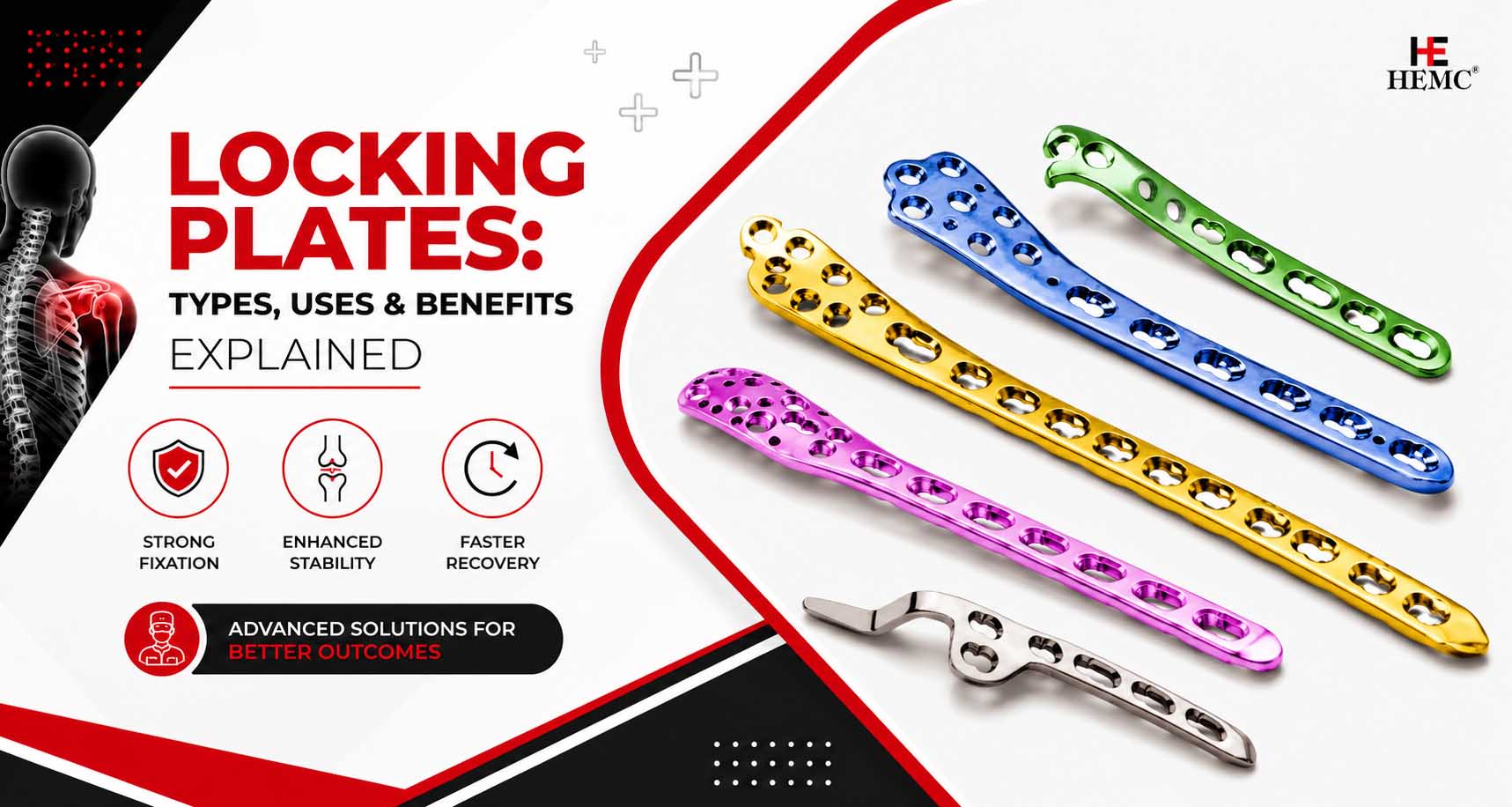
Locking plates are advanced internal fixation devices designed to stabilize fractured bones. Unlike conventional bone plates, they incorporate threaded holes that accept matching Locking Screws. Once tightened, the screw locks into the plate, forming a rigid, fixed-angle construct.
This design offers several advantages:
- Enhanced mechanical stability
- Reduced risk of screw loosening
- Better fixation in osteoporotic bone
- Less dependence on plate-to-bone compression
- Improved preservation of periosteal blood supply
Because of these advantages, locking plate technology has become one of the most trusted solutions in trauma and reconstructive orthopaedic procedures.
How Locking Plate Systems Work
The principle behind locking plate technology is relatively simple but highly effective.
Traditional plates compress the bone by tightening screws against the plate surface. In contrast, locking systems use threaded screw heads that engage directly with threaded plate holes. The resulting construct behaves as a single stable framework rather than relying on friction alone.
This approach is particularly valuable for:
- Multi-fragment fractures
- Osteoporotic bone
- Metaphyseal fractures
- Periarticular fractures
- Revision surgeries
The fixed-angle support helps maintain fracture reduction while allowing biological healing to occur with minimal disruption to surrounding tissues.
Types of Locking Plates
Modern orthopaedic surgery utilizes a wide range of locking plate systems designed for different bones and fracture configurations.
Locking Reconstruction Plate
The Locking Reconstruction Plate is highly versatile and commonly used in pelvic, clavicular, scapular, and long bone reconstruction procedures. Its contourable design allows surgeons to adapt the plate to complex anatomical shapes while maintaining strong fixation.
Common applications include:
- Pelvic fractures
- Acetabular reconstruction
- Clavicle fractures
- Scapular injuries
- Complex trauma reconstruction
Locking Tubular Plate
The Locking Tubular Plate is frequently used for fractures involving smaller bones where low-profile implants are preferred.
Applications include:
- Fibula fractures
- Radius fractures
- Ulna fractures
- Ankle fractures
- Small bone trauma
Its slim profile minimizes soft tissue irritation while maintaining excellent fixation strength.
Locking LC Dynamic Compression Plate
The Locking LC Dynamic Compression Plate combines conventional compression plating with locking technology.
Advantages include:
- Dynamic compression capability
- Fixed-angle stability
- Versatile screw options
- Improved fracture compression
- Suitable for both simple and complex fractures
This plate is often selected when surgeons require both compression and angular stability within a single implant.
Locking Clavicle Hook Plate
The Locking Clavicle Hook Plate is specifically designed for distal clavicle fractures and acromioclavicular joint injuries.
Key benefits include:
- Stable fixation of distal clavicle fractures
- Restoration of shoulder alignment
- Improved healing outcomes
- Early rehabilitation
Its hook portion engages beneath the acromion while locking screws stabilize the clavicle.
Locking Scapula Lateral Border Plate
Scapular fractures are relatively uncommon but often require specialized implants. The Locking Scapula Lateral Border Plate is anatomically contoured to fit the lateral border of the scapula.
It provides:
- Excellent anatomical fit
- Stable fixation
- Reduced surgical contouring
- Improved shoulder function
Locking Proximal Humerus Plate
The Locking Proximal Humerus Plate is among the most widely used implants for shoulder fractures, especially in elderly patients with osteoporosis.
It offers:
- Multiple locking screw trajectories
- Strong fixation of the humeral head
- Support for complex fractures
- Early mobilization
This implant has become a preferred choice for proximal humeral fractures.
Locking Proximal Humerus Altos Plate
The Locking Proximal Humerus Altos Plate is an advanced anatomical plate designed for improved fixation of proximal humerus fractures.
Features include:
- Low-profile design
- Enhanced anatomical contour
- Multi-directional screw placement
- Improved fixation in osteoporotic bone
These characteristics contribute to reduced soft tissue irritation and enhanced patient comfort.
Locking PHILOS Proximal Humerus Internal Plate
The Locking PHILOS Proximal Humerus Internal Plate is considered one of the gold standards for treating proximal humeral fractures.
Its advanced design includes:
- Divergent locking screw configuration
- Excellent angular stability
- High resistance to varus collapse
- Strong support for osteoporotic bone
The PHILOS system is especially effective in treating displaced multi-part fractures.
Locking Distal Humerus Medial Plate
Fractures involving the distal humerus require precise anatomical reconstruction. The Locking Distal Humerus Medial Plate provides strong medial column support.
Applications include:
- Distal humerus fractures
- Intercondylar fractures
- Supracondylar fractures
- Revision surgeries
Its anatomical shape helps restore elbow function while ensuring rigid fixation.
Locking Distal Humerus DORSO Plate with Lateral Support
The Locking Distal Humerus DORSO Plate with Lateral Support is specifically designed for complex distal humerus fractures.
Its unique design provides:
- Enhanced lateral support
- Stable fixation
- Improved rotational control
- Better fracture alignment
This plate is particularly useful for highly comminuted fractures.
Locking LCP Olecranon Plate
The Locking LCP Olecranon Plate is intended for fractures involving the olecranon and proximal ulna.
Advantages include:
- Anatomical contour
- Stable fixation
- Multiple locking screw options
- Early elbow mobilization
It is commonly used in displaced olecranon fractures requiring surgical intervention.
Locking Olecranon Plate Universal
The Locking Olecranon Plate Universal is designed to accommodate various olecranon fracture patterns while minimizing the need for extensive implant inventory.
Its benefits include:
- Universal anatomical compatibility
- Strong fixation
- Reduced implant inventory
- Flexible surgical application
This implant offers surgeons greater versatility during fracture management.
Advantages of Locking Screws
The performance of locking plates depends largely on the use of Locking Screws, which create a fixed-angle connection between the screw and the plate.
Major advantages include:
- Reduced screw loosening
- Better fixation in weak bone
- Increased angular stability
- Improved resistance to pull-out
- Preservation of bone vascularity
- Less implant failure
These characteristics make locking screws indispensable in modern fracture fixation.
Benefits of Locking Plate Technology
The growing popularity of locking plate systems is driven by numerous clinical advantages.
Superior Stability
- Locking plates form a stable internal framework capable of maintaining fracture alignment under physiological loads.
Better Osteoporotic Bone Fixation
- Patients with osteoporosis often have poor bone quality. Locking constructs provide significantly better fixation compared to conventional plating systems.
Biological Fixation
- Because locking plates require less compression against the bone, they preserve periosteal blood supply and encourage biological healing.
Early Rehabilitation
- Stable fixation allows patients to begin controlled movement earlier, reducing stiffness and improving functional recovery.
Reduced Implant Failure
- The rigid screw-plate interface minimizes screw loosening and decreases the likelihood of implant failure.
Versatility
- From simple fractures to highly comminuted injuries, locking plate systems are available for nearly every anatomical region.
Clinical Applications
Locking plate systems are extensively used in treating:
- Shoulder fractures
- Clavicle fractures
- Humerus fractures
- Olecranon fractures
- Scapular fractures
- Pelvic fractures
- Long bone fractures
- Periarticular fractures
- Osteoporotic fractures
- Complex trauma cases
Their versatility makes them one of the most important categories of Orthopaedic Implants available today.
Choosing the Right Locking Plate
Selecting the appropriate implant depends on several factors, including:
- Fracture location
- Bone quality
- Patient age
- Fracture complexity
- Soft tissue condition
- Surgeon preference
- Rehabilitation goals
Anatomically pre-contoured locking plates often reduce operative time while improving overall fixation.
Future of Locking Plate Technology
Advances in orthopaedic engineering continue to improve locking plate systems. Modern implants feature thinner profiles, enhanced anatomical contours, variable-angle locking mechanisms, and biocompatible materials such as titanium and stainless steel.
Computer-assisted surgical planning, patient-specific instrumentation, and additive manufacturing are also contributing to the evolution of next-generation Orthopaedic Implants, allowing surgeons to achieve even greater precision and improved patient outcomes.
Conclusion
Locking plate technology has revolutionized fracture management by providing superior fixation, enhanced stability, and better biological healing than conventional plating systems. Whether treating clavicle fractures with a Locking Clavicle Hook Plate, shoulder injuries using a Locking PHILOS Proximal Humerus Internal Plate, elbow trauma with a Locking LCP Olecranon Plate, or complex reconstructions using a Locking Reconstruction Plate, these implants play a vital role in modern orthopaedic surgery.
With the support of advanced Locking Screws, anatomically contoured designs, and innovative engineering, locking plate systems have become indispensable Orthopaedic Implants for managing a wide range of fractures. As implant technology continues to evolve, locking plates will remain at the forefront of trauma care, helping surgeons achieve reliable fixation, faster recovery, and improved long-term outcomes for patients worldwide.