

The scapula, commonly known as the shoulder blade, plays a crucial role in shoulder mobility, stability, and upper limb function. Although scapular fractures are relatively uncommon, they often result from high-energy trauma such as road traffic accidents, falls from height, or sports injuries. Due to the complex anatomy of the scapula, achieving stable fixation can be challenging. Fortunately, advancements in orthopaedic implants have significantly improved the surgical management of these injuries.
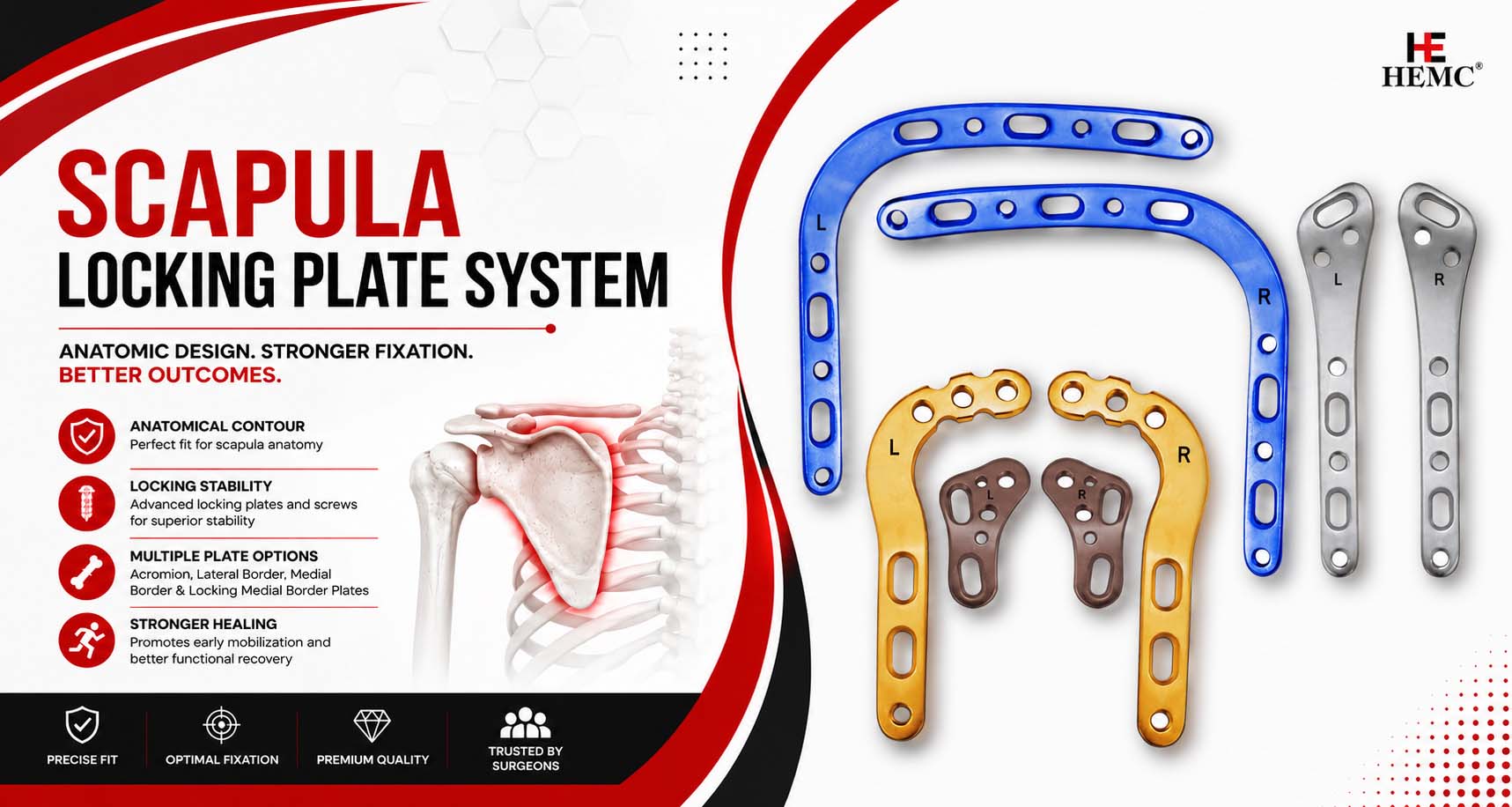
The Scapula Locking Plate System is specifically designed to provide anatomical fixation for various fracture patterns involving different regions of the scapula. With specialized implants such as the scapula acromion plate, scapula lateral border plate, scapula medial border plate, and locking scapula medial border plate, surgeons can achieve stable fixation while preserving shoulder function and promoting faster recovery.
Understanding Scapular Fractures
The scapula is a flat triangular bone located on the posterior aspect of the thoracic cage. It serves as the attachment site for numerous muscles and forms part of the shoulder joint.
Scapular fractures account for less than 1% of all fractures but frequently occur alongside multiple traumatic injuries.
Common causes include:
- Motor vehicle accidents
- Falls from significant heights
- Sports injuries
- Industrial accidents
- Direct trauma to the shoulder
Depending on the fracture location, patients may experience pain, swelling, reduced shoulder movement, and instability.
Fractures commonly involve:
- Acromion
- Scapular body
- Lateral border
- Medial border
- Glenoid cavity
- Scapular neck
Complex fracture patterns often require surgical stabilization using dedicated fixation systems.
What Is a Scapula Locking Plate System?
A Scapula Locking Plate System is a comprehensive collection of anatomically contoured fixation plates specifically developed for treating fractures of various scapular regions.
Unlike conventional plates, these implants utilize advanced locking plates and screws technology, creating a fixed-angle construct that enhances stability while minimizing the risk of screw loosening.
The system includes multiple plate configurations designed to match the complex anatomy of the scapula, allowing orthopaedic surgeons to select the most suitable implant for each fracture pattern.
Components of the Scapula Locking Plate System
Scapula Acromion Plate
The scapula acromion plate is designed for fractures involving the acromion process.
Its anatomical contour closely matches the superior shoulder anatomy while providing excellent fixation using multiple locking screw options.
Benefits include:
- Strong fixation
- Low-profile design
- Reduced soft tissue irritation
- Early mobilization
- Anatomical fit
Scapula Lateral Border Plate
The scapula lateral border plate is intended for fractures involving the lateral border of the scapula.
The implant follows the natural curvature of the lateral border while offering multiple locking screw holes for secure fixation.
Its advantages include:
- Superior angular stability
- Excellent fracture compression
- High mechanical strength
- Preservation of surrounding soft tissues
Scapula Medial Border Plate
The scapula medial border plate provides stable fixation for fractures involving the medial aspect of the scapula.
Its anatomical shape minimizes intraoperative contouring while ensuring excellent implant-to-bone contact.
The plate supports stable healing even in complex fracture configurations.
Locking Scapula Medial Border Plate
The locking scapula medial border plate combines anatomical contouring with locking screw technology to maximize fixation stability.
This implant is particularly beneficial in:
- Osteoporotic bone
- Comminuted fractures
- Revision surgeries
- Delayed unions
The fixed-angle construct minimizes screw loosening while enhancing overall construct rigidity.
Key Features of the Scapula Locking Plate System
Modern scapular fixation systems offer several advanced features:
- Anatomically pre-contoured plates
- Low-profile implant design
- Titanium or stainless steel construction
- Multiple locking screw options
- Fixed-angle technology
- Left and right configurations
- Rounded edges to reduce soft tissue irritation
- High fatigue strength
- Precision-machined screw holes
- Excellent biomechanical stability
These characteristics contribute to improved surgical outcomes and patient comfort.
Advantages of Locking Plates and Screws
Modern locking plates and screws have revolutionized fracture fixation by providing several biomechanical advantages over traditional plating systems.
Major benefits include:
Fixed-Angle Stability
- Locking screws engage directly with the plate, creating a rigid construct that resists displacement.
Better Performance in Osteoporotic Bone
- The fixation strength does not depend entirely on bone quality, making it ideal for elderly patients.
Reduced Screw Loosening
- The threaded screw-plate interface minimizes screw back-out during healing.
Enhanced Load Distribution
- Mechanical forces are evenly distributed throughout the implant, reducing stress concentration.
Faster Rehabilitation
- Stable fixation allows earlier shoulder mobilization and functional recovery.
Clinical Indications
The Scapula Locking Plate System is commonly indicated for:
- Acromion fractures
- Scapular body fractures
- Lateral border fractures
- Medial border fractures
- Glenoid fractures
- Scapular neck fractures
- Comminuted fractures
- Delayed union
- Nonunion
- Revision fixation
Proper implant selection depends on fracture location, bone quality, and patient-specific anatomical considerations.
Surgical Procedure Overview
Successful fixation begins with detailed preoperative planning.
Preoperative Assessment
Surgeons evaluate fracture configuration using:
- X-rays
- CT scans
- 3D imaging
Surgical Exposure
Depending on fracture location, posterior or modified surgical approaches provide adequate visualization.
Fracture Reduction
Bone fragments are carefully realigned to restore anatomical relationships.
Plate Selection
The appropriate scapula acromion plate, scapula lateral border plate, scapula medial border plate, or locking scapula medial border plate is selected based on fracture pattern.
Plate Fixation
Multiple locking plates and screws secure the implant to the bone while maintaining anatomical reduction.
Closure
Following fluoroscopic confirmation of implant position, soft tissues are repaired and the incision is closed.
Rehabilitation Following Surgery
Recovery depends on fracture severity and patient compliance.
Typical rehabilitation includes:
Phase 1
- Sling support
- Pain management
- Gentle pendulum exercises
Phase 2
- Passive shoulder movement
- Range-of-motion exercises
- Scapular stabilization
Phase 3
- Active strengthening
- Progressive resistance training
- Functional shoulder exercises
Phase 4
- Return to sports
- Occupational activities
- Full functional recovery
A structured rehabilitation program significantly improves long-term outcomes.
Materials Used in Manufacturing
Premium orthopaedic implants are manufactured using high-quality biomaterials.
Common materials include:
Titanium Alloy
Advantages:
- Lightweight
- Excellent corrosion resistance
- High strength
- Superior biocompatibility
- MRI compatibility
Stainless Steel
Benefits include:
- High durability
- Cost-effectiveness
- Excellent mechanical properties
- Proven clinical performance
Both materials undergo strict quality testing to ensure safety and reliability.
The Role of Orthopaedic Implants in Modern Trauma Care
Today’s orthopaedic implants extend far beyond scapular fixation. Comprehensive trauma care relies on a wide range of specialized implant systems designed to restore anatomy and function across different parts of the musculoskeletal system.
Some of the most commonly used implant categories include:
- Locking plates and screws for fracture stabilization
- Interlocking nails for long bone fractures such as the femur and tibia
- Spine implants for spinal trauma, deformity correction, and degenerative conditions
- Hip implants for hip fractures and joint reconstruction
- Hip prosthesis systems for total and partial hip replacement procedures
- External fixators for temporary or definitive stabilization of complex fractures
- General instrument sets that support orthopaedic surgical procedures with precision and efficiency
- Arthroscopy instruments for minimally invasive diagnosis and treatment of shoulder, knee, and other joint disorders
Together, these technologies allow surgeons to provide personalized treatment based on fracture type, patient anatomy, and clinical requirements.
Why Anatomically Contoured Plates Matter
The scapula has one of the most complex shapes in the human skeleton.
Anatomically pre-contoured implants offer several advantages:
- Reduced intraoperative bending
- Shorter operative time
- Better implant fit
- Improved fracture reduction
- Less soft tissue irritation
- Enhanced biomechanical stability
These design improvements contribute to better clinical outcomes and reduced complication rates.
Potential Complications
Although modern fixation systems provide excellent outcomes, possible complications include:
- Infection
- Implant irritation
- Hardware prominence
- Delayed union
- Nonunion
- Screw loosening
- Implant failure
- Shoulder stiffness
- Nerve irritation
Most complications can be minimized through proper surgical planning, precise implant placement, and adherence to rehabilitation protocols.
Choosing High-Quality Orthopaedic Implants
Selecting premium orthopaedic implants is essential for successful fracture fixation.
Surgeons often look for implants that offer:
- Anatomical precision
- High-quality materials
- Excellent locking technology
- Multiple size options
- Superior fatigue resistance
- Reliable clinical performance
- Compliance with international quality standards
Manufacturers that prioritize precision engineering and rigorous quality control help ensure consistent surgical outcomes.
Conclusion
The Scapula Locking Plate System represents a major advancement in the treatment of complex scapular fractures. Specialized implants such as the scapula acromion plate, scapula lateral border plate, scapula medial border plate, and locking scapula medial border plate provide orthopaedic surgeons with anatomically designed solutions that deliver stable fixation, promote faster healing, and restore shoulder function.
Combined with advanced locking plates and screws, these implants improve biomechanical stability while reducing the risk of fixation failure, even in osteoporotic or comminuted fractures.
As modern orthopaedic implants continue to evolve, complementary technologies including interlocking nails, spine implants, hip implants, hip prosthesis, external fixators, general instrument systems, and arthroscopy equipment continue to expand the capabilities of orthopaedic surgery. Together, these innovations enable surgeons to provide safer, more effective, and patient-specific treatments that support faster recovery and improved quality of life.