

Hip fractures, particularly those involving the proximal femur, are among the most common orthopaedic injuries worldwide. They frequently occur in elderly patients due to osteoporosis but can also affect younger individuals following high-energy trauma such as road traffic accidents or falls from height. Modern orthopaedic surgery relies on advanced internal fixation devices that provide superior stability while allowing early mobilization. One of the most widely accepted implants for treating these fractures is the Gamma Nail.
The Gamma Nail is an intramedullary fixation system specifically designed to stabilize fractures of the proximal femur, including intertrochanteric, subtrochanteric, and certain femoral neck fractures. Its biomechanical design offers excellent load sharing, reduced surgical trauma, and improved patient outcomes compared to traditional plate fixation systems.
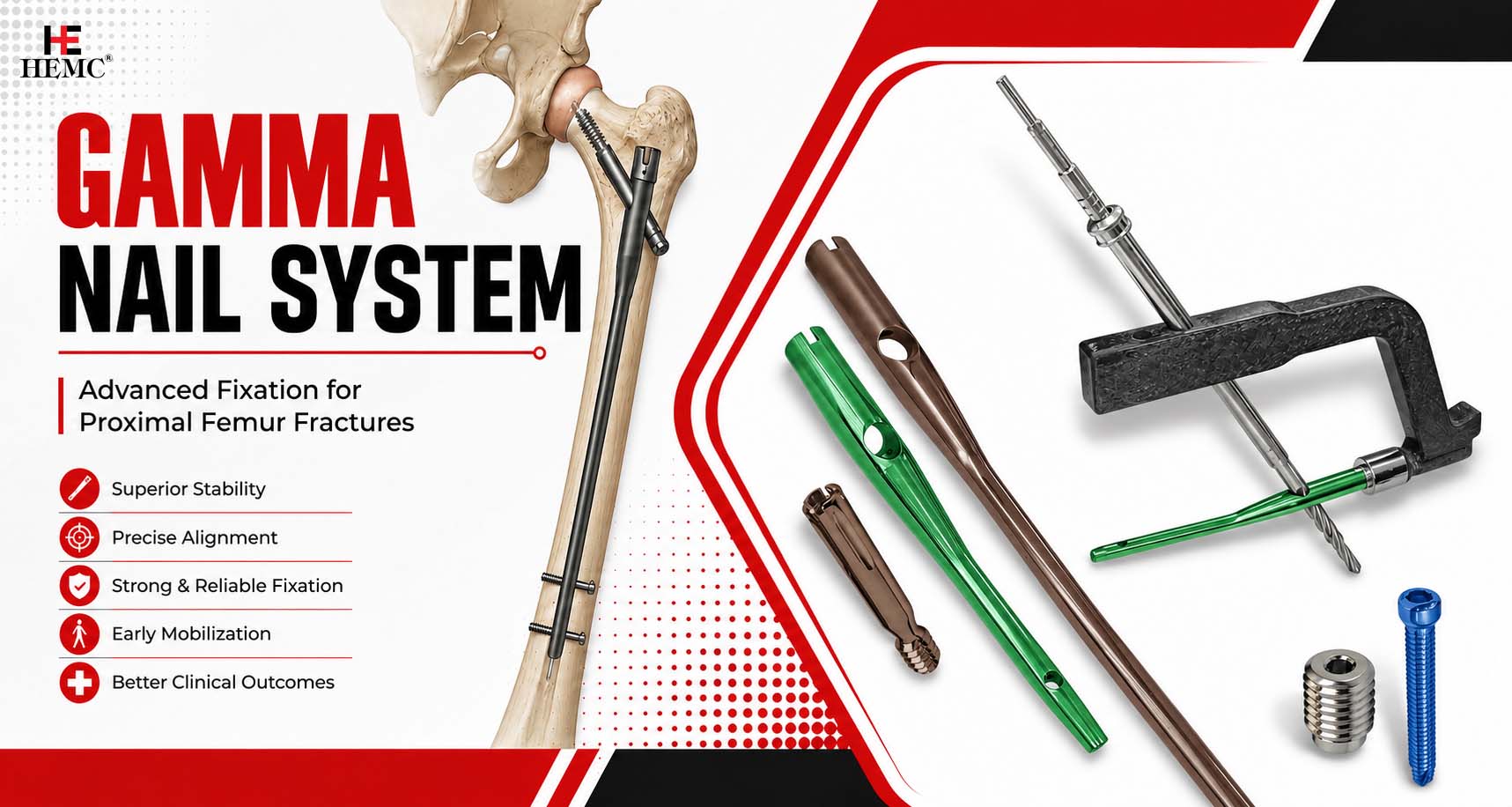
A complete Gamma Nail system consists of several precisely engineered components, including the Gamma Nail 130° Short, Gamma Nail 130° Long, Gamma Lag Screw, End Cap for Gamma Nail, and a dedicated Instrument Set for Gamma Nail. Together, these implants and instruments enable orthopaedic surgeons to perform accurate, minimally invasive fixation procedures with excellent clinical results.
What is a Gamma Nail?
A Gamma Nail is an intramedullary orthopaedic implant inserted into the medullary canal of the femur to stabilize fractures occurring near the hip joint. Unlike traditional plates that are attached to the outside of the bone, the Gamma Nail is positioned inside the bone, making it biomechanically stronger and closer to the body’s natural weight-bearing axis.
Developed to improve fixation of unstable proximal femoral fractures, the Gamma Nail provides rotational stability, prevents excessive collapse, and enables patients to begin walking sooner after surgery.
Its minimally invasive insertion technique reduces soft tissue damage, blood loss, and operating time while promoting faster recovery.
Components of the Gamma Nail System
A complete Gamma Nail fixation system includes multiple implants and surgical instruments that work together to achieve stable fracture fixation.
Gamma Nail 130° Short
The Gamma Nail 130° Short is commonly used for treating stable and unstable intertrochanteric fractures where fracture extension is limited to the proximal femur.
Key features include:
- 130° neck angle for optimal anatomical alignment
- Short intramedullary design
- Reduced surgical exposure
- Excellent rotational stability
- Minimal blood loss
- Faster surgical procedure
- Early weight-bearing capability
Because of its shorter length, it is especially suitable for elderly patients with isolated proximal femoral fractures.
Gamma Nail 130° Long
The Gamma Nail 130° Long is designed for more complex fracture patterns involving the subtrochanteric region or fractures extending into the femoral shaft.
Advantages include:
- Longer intramedullary support
- Increased stability in unstable fractures
- Better stress distribution
- Reduced risk of secondary fractures
- Suitable for pathological fractures
- Effective in revision surgeries
The long Gamma Nail offers superior fixation for fractures subjected to high mechanical stress.
Gamma Lag Screw
The Gamma Lag Screw is one of the most critical components of the Gamma Nail system. It passes through the proximal nail into the femoral head and neck, providing controlled compression across the fracture site.
Functions include:
- Secure fixation of the femoral head
- Controlled fracture compression
- Prevention of rotational displacement
- Maintenance of anatomical alignment
- Enhanced fracture healing
Available in multiple diameters and lengths, the Gamma Lag Screw allows surgeons to choose the most appropriate size for individual patient anatomy.
End Cap for Gamma Nail
The End Cap for Gamma Nail is installed at the proximal end of the nail after implantation.
Its functions include:
- Preventing tissue ingrowth
- Providing additional locking stability
- Maintaining implant positioning
- Simplifying implant removal if required
- Improving overall construct integrity
Although relatively small, the End Cap plays a significant role in the long-term performance of the fixation system.
Instrument Set for Gamma Nail
The Instrument Set for Gamma Nail contains all specialized surgical tools required for precise implantation.
A standard instrument set generally includes:
- Guide wires
- Reamers
- Drill sleeves
- Targeting devices
- Nail inserters
- Screwdrivers
- Depth gauges
- Bone awls
- Extraction instruments
- Alignment guides
A high-quality Instrument Set for Gamma Nail ensures accurate implant placement, shorter operating time, and improved surgical efficiency.
Indications for Gamma Nail Fixation
The Gamma Nail system is indicated for treating various proximal femoral fractures, including:
- Intertrochanteric fractures
- Subtrochanteric fractures
- Combined intertrochanteric and subtrochanteric fractures
- Reverse oblique fractures
- Pathological fractures
- Certain femoral shaft fractures extending proximally
- Revision fixation procedures
Orthopaedic surgeons evaluate fracture type, patient age, bone quality, and overall health before selecting the appropriate implant configuration.
Surgical Procedure
Gamma Nail fixation is performed under fluoroscopic guidance in a sterile operating room.
Step 1: Patient Positioning
- The patient is positioned on a fracture table, allowing proper reduction under image intensification.
Step 2: Fracture Reduction
- The fractured femur is carefully aligned to restore normal anatomy.
Step 3: Entry Point
- A small incision is made over the greater trochanter, and the medullary canal is accessed.
Step 4: Nail Insertion
- Depending on fracture characteristics, either the Gamma Nail 130° Short or Gamma Nail 130° Long is inserted into the femoral canal.
Step 5: Lag Screw Placement
- The Gamma Lag Screw is accurately positioned into the femoral head using the targeting guide.
Step 6: Distal Locking
- Distal locking screws secure rotational and axial stability.
Step 7: End Cap Placement
- The End Cap for Gamma Nail is fitted to complete the implant assembly.
Step 8: Final Imaging
- Fluoroscopic images confirm satisfactory implant placement and fracture reduction before wound closure.
Advantages of Gamma Nail Fixation
The Gamma Nail system has become the preferred treatment option because of its numerous clinical benefits.
Minimally Invasive Technique
- Smaller incisions preserve soft tissues, reducing postoperative pain and promoting faster recovery.
Strong Biomechanical Stability
- As an intramedullary implant, the Gamma Nail aligns closely with the body’s mechanical axis, reducing bending forces.
Early Mobilization
- Stable fixation allows patients to begin physiotherapy and weight-bearing earlier, minimizing complications associated with prolonged bed rest.
Reduced Blood Loss
- Compared with traditional plating techniques, Gamma Nail surgery generally results in lower intraoperative blood loss.
Lower Infection Risk
- Smaller surgical exposure decreases the likelihood of postoperative infections.
Faster Rehabilitation
- Patients often regain mobility sooner, improving overall quality of life.
Benefits for Orthopaedic Surgeons
The Gamma Nail system offers several intraoperative advantages:
- Reliable targeting instrumentation
- Shorter operating time
- Accurate implant positioning
- Reduced fluoroscopy exposure
- Versatile implant options
- Excellent fixation in osteoporotic bone
- Compatibility with minimally invasive techniques
These benefits contribute to improved surgical efficiency and reproducible clinical outcomes.
Materials Used
Modern Gamma Nails are manufactured from premium orthopaedic-grade materials such as:
- Titanium Alloy
- Stainless Steel (316L Surgical Grade)
Titanium implants are particularly popular because they offer:
- Excellent biocompatibility
- High corrosion resistance
- Lightweight construction
- Superior fatigue strength
- MRI compatibility
Postoperative Care
Successful outcomes depend on appropriate postoperative management.
Typical rehabilitation includes:
- Early physiotherapy
- Progressive weight-bearing
- Pain management
- Regular X-ray follow-up
- Muscle strengthening exercises
- Fall prevention strategies
- Nutritional support for bone healing
Most fractures heal within several months, depending on patient age, bone quality, and fracture complexity.
Choosing the Right Gamma Nail System
When selecting a Gamma Nail system, hospitals and orthopaedic surgeons should consider:
- Implant material quality
- Manufacturing precision
- Availability of multiple nail lengths
- Accurate 130° neck angle
- Comprehensive Instrument Set for Gamma Nail
- Compatible Gamma Lag Screw sizes
- Reliable End Cap options
- Sterilization compatibility
- Regulatory certifications
- Trusted manufacturer support
High-quality orthopaedic implants contribute significantly to improved patient outcomes and long-term implant performance.
Conclusion
The Gamma Nail has revolutionized the management of proximal femoral fractures by combining minimally invasive surgical techniques with superior biomechanical stability. Whether using the Gamma Nail 130° Short for standard intertrochanteric fractures or the Gamma Nail 130° Long for complex subtrochanteric injuries, the system provides dependable fixation and facilitates faster rehabilitation.
Supporting components such as the Gamma Lag Screw, End Cap for Gamma Nail, and the dedicated Instrument Set for Gamma Nail ensure accurate implantation and long-term construct stability. Together, these components form a comprehensive orthopaedic solution that meets the demanding requirements of modern trauma surgery.
As the incidence of hip fractures continues to rise with an aging population, Gamma Nail systems remain an essential choice for orthopaedic surgeons seeking reliable fixation, early patient mobilization, and excellent clinical outcomes.