


Pelvic injuries and disorders represent some of the most complex challenges in modern orthopaedics. Due to the intricate anatomy of the pelvic ring and its proximity to vital organs and neurovascular structures, effective treatment requires both precision and advanced medical technology. Among the most critical innovations in this domain are pelvic screws and plates, which play a central role in stabilizing fractures and supporting reconstruction procedures. As a key category within orthopaedic implants, these devices have significantly improved patient outcomes in trauma care and reconstructive surgery.
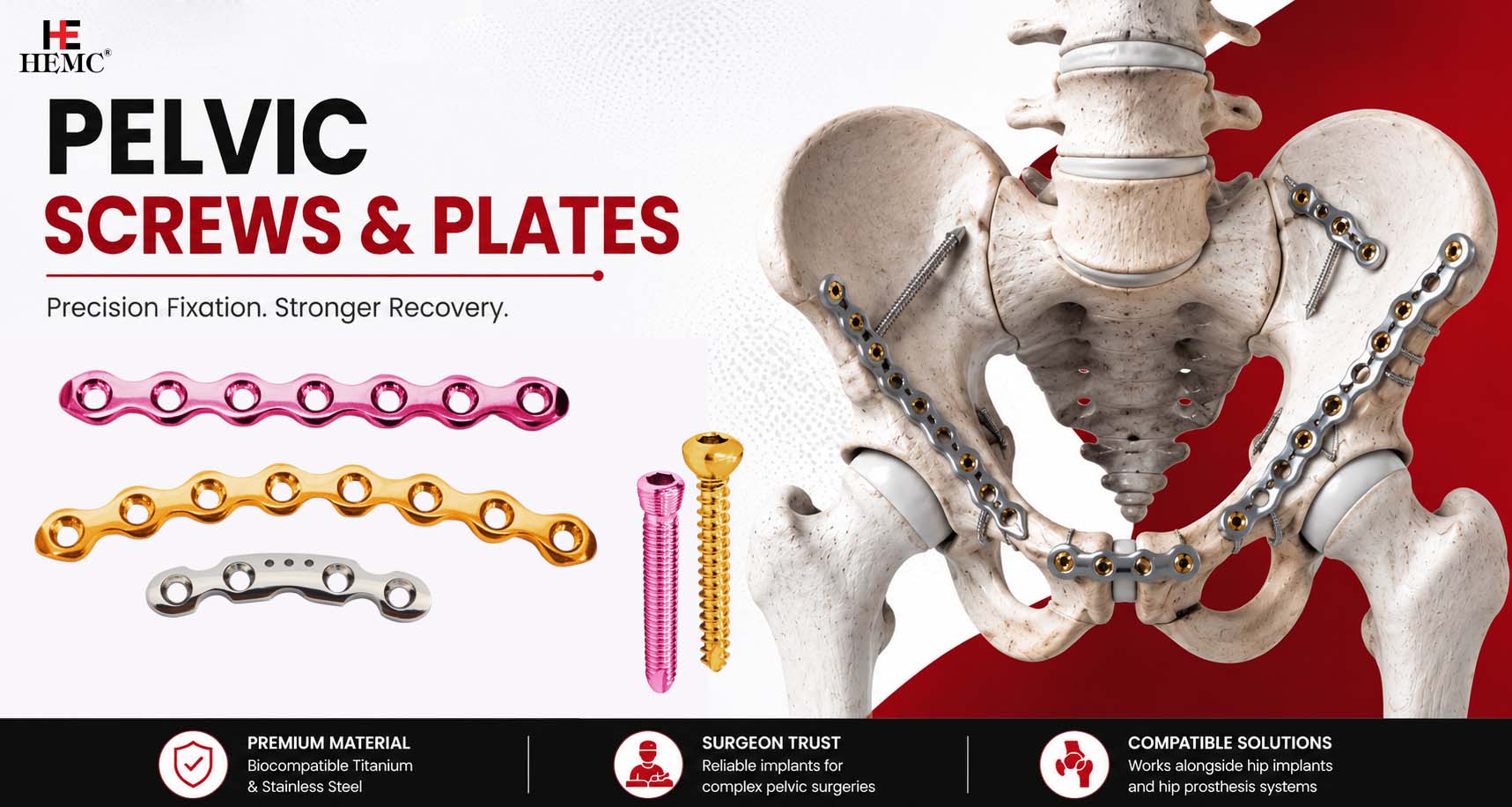
Understanding the Pelvic Anatomy and Injury Complexity
The pelvis is a ring-like bony structure composed of the ilium, ischium, pubis, sacrum, and coccyx. It connects the spine to the lower limbs and supports body weight during standing, walking, and other movements. Because of its structural importance, any disruption to the pelvic ring—whether due to trauma, degenerative conditions, or surgical intervention—can lead to severe functional impairment.
Pelvic fractures often result from high-energy trauma such as road accidents or falls from height. In elderly patients, low-energy fractures may occur due to osteoporosis. Regardless of the cause, restoring pelvic stability is essential to prevent complications such as chronic pain, immobility, and organ damage.
Role of Pelvic Screws & Plates in Orthopaedic Implants
Pelvic screws and plates are specialized orthopaedic implants designed to stabilize fractures and facilitate bone healing. These devices are typically made from biocompatible materials such as titanium or stainless steel, ensuring durability and compatibility with human tissue.
Pelvic plates are contoured metal structures that are fixed along the surface of the bone to hold fractured segments in proper alignment. Screws are used in conjunction with plates or independently to anchor bone fragments securely. Together, they provide rigid fixation, allowing early mobilization and reducing the risk of complications.
In complex pelvic injuries, surgeons often use a combination of plates and screws to reconstruct the pelvic ring. These implants are carefully selected based on fracture type, patient anatomy, and surgical approach.
Types of Pelvic Screws and Plates
Pelvic fixation systems come in various designs to accommodate different clinical scenarios:
Reconstruction Plates
- These are flexible plates that can be contoured intraoperatively to match the pelvic anatomy. They are commonly used in acetabular fractures.
Locking Plates
- Locking plates provide enhanced stability by allowing screws to lock into the plate, creating a fixed-angle construct. This is particularly useful in osteoporotic bone.
Cortical and Cancellous Screws
- Cortical screws are used in dense bone areas, while cancellous screws are designed for spongy bone regions. Both are essential in pelvic fixation.
Cannulated Screws
- These screws are inserted over a guidewire, enabling precise placement, especially in minimally invasive procedures.
Sacroiliac Screws
- Specifically designed for fixation of the sacroiliac joint, these screws are critical in stabilizing posterior pelvic injuries.
Integration with Hip Implants and Hip Prosthesis
Pelvic screws and plates are often used alongside hip implants and hip prosthesis systems, particularly in cases involving acetabular fractures or hip joint reconstruction. The acetabulum, which forms the socket of the hip joint, is a critical component that must be accurately restored to ensure proper hip function.
In total hip replacement surgeries, a hip prosthesis may be implanted to replace the damaged joint. However, if the acetabulum is fractured or weakened, pelvic plates and screws are used to reconstruct the socket before placing the prosthesis. This ensures a stable foundation for the implant and enhances long-term success.
The synergy between pelvic fixation devices and hip implants underscores the importance of comprehensive orthopaedic solutions. Modern surgical techniques often combine these technologies to achieve optimal alignment, stability, and mobility.
Materials and Biomechanical Considerations
The effectiveness of pelvic screws and plates depends heavily on their material properties and biomechanical performance. Titanium alloys are widely preferred due to their high strength-to-weight ratio, corrosion resistance, and excellent biocompatibility. Stainless steel is also used but may be less favorable in long-term implantation.
Biomechanically, these implants must withstand significant forces during weight-bearing activities. Advanced design features such as locking mechanisms, variable angle screw placement, and anatomical contouring enhance stability and reduce the risk of implant failure.
Surgical Techniques and Innovations
The application of pelvic screws and plates requires specialized surgical expertise. Traditional open reduction and internal fixation (ORIF) remains a common approach, allowing direct visualization of the fracture. However, minimally invasive techniques are gaining popularity due to reduced soft tissue damage and faster recovery.
Image-guided navigation and intraoperative fluoroscopy have improved the accuracy of screw placement, minimizing risks to surrounding structures. Robotic-assisted surgery is also emerging as a promising advancement in orthopaedic implant procedures.
Preoperative planning using 3D imaging and patient-specific models allows surgeons to select the most appropriate implant configuration. Custom-designed plates tailored to individual anatomy are becoming increasingly feasible with advancements in additive manufacturing.
Clinical Outcomes and Benefits
The use of pelvic screws and plates has led to significant improvements in clinical outcomes. Key benefits include:
Enhanced Stability: Rigid fixation promotes proper bone healing.
Early Mobilization: Patients can begin rehabilitation sooner, reducing complications such as deep vein thrombosis.
Improved Alignment: Accurate reconstruction of the pelvic ring and acetabulum restores normal biomechanics.
Reduced Pain: Stabilization minimizes movement at the fracture site, alleviating discomfort.
When combined with hip implants or a hip prosthesis, these devices enable comprehensive treatment of complex injuries, restoring both structural integrity and joint function.
Challenges and Risks
Despite their advantages, pelvic screws and plates are not without challenges. Potential complications include infection, implant loosening, nerve injury, and malposition of screws. The complexity of pelvic anatomy increases the risk of surgical errors, making experience and precision critical.
In some cases, hardware removal may be necessary due to discomfort or complications. However, advances in implant design and surgical techniques continue to reduce these risks.
Market Trends and Future Outlook
The global market for orthopaedic implants, including pelvic screws and plates, is experiencing steady growth. Factors driving this trend include an aging population, increasing incidence of trauma injuries, and advancements in medical technology.
There is a growing demand for minimally invasive solutions, patient-specific implants, and smart devices capable of monitoring healing progress. Integration with digital health technologies and AI-driven surgical planning is expected to further transform the field.
Manufacturers are also focusing on improving implant materials, surface coatings, and design ergonomics to enhance performance and patient outcomes. Sustainability and cost-effectiveness are becoming important considerations in healthcare systems worldwide.
Conclusion
Pelvic screws and plates are indispensable components of modern orthopaedic implants, playing a vital role in the treatment of pelvic fractures and reconstruction procedures. Their integration with hip implants and hip prosthesis systems highlights their importance in comprehensive musculoskeletal care.
As technology continues to evolve, these devices are becoming more advanced, precise, and patient-specific. With ongoing innovations in materials, surgical techniques, and digital integration, the future of pelvic fixation looks promising.
For healthcare providers, understanding the capabilities and applications of pelvic screws and plates is essential for delivering effective treatment. For patients, these advancements offer improved outcomes, faster recovery, and a better quality of life.
In the broader context of orthopaedics, pelvic fixation systems exemplify how engineering and medicine can work together to address complex clinical challenges and enhance human mobility.