


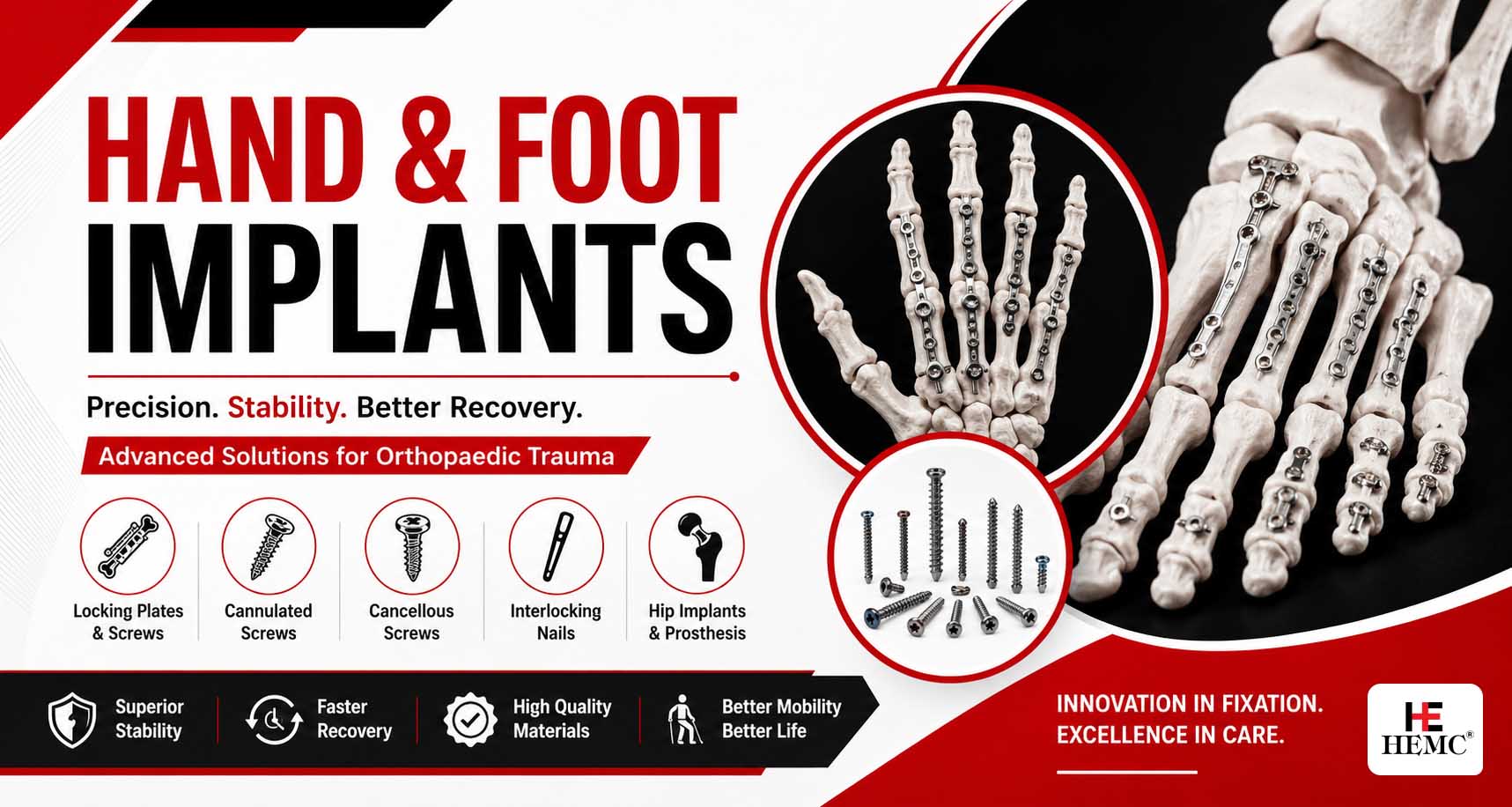
Hand and foot injuries and deformities can significantly affect mobility, dexterity, and overall quality of life. Thanks to modern advancements in orthopaedic implant technology, surgeons can effectively restore function, correct deformities, and accelerate patient recovery. From fractures and trauma cases to reconstructive surgeries, specialized implants provide the stability and support necessary for successful bone healing.
The demand for high-quality implants has increased worldwide, with innovations in locking plates and screws, cannulated screws, cancellous screws, and advanced fixation systems transforming orthopaedic procedures. Hand and foot implants are now designed to offer superior anatomical fit, enhanced stability, and improved clinical outcomes.
Understanding Hand and Foot Implants
Hand and foot implants are medical devices specifically developed to stabilize fractures, repair damaged bones, and restore normal function in small and complex skeletal structures. These implants are manufactured using biocompatible materials such as stainless steel and titanium alloys to ensure strength, corrosion resistance, and compatibility with the human body.
These implants are commonly used for:
- Fracture fixation
- Osteotomy procedures
- Joint reconstruction
- Trauma surgeries
- Corrective surgeries for deformities
- Fusion procedures
- Sports injury treatments
Modern hand and foot fixation systems include plates, screws, wires, pins, and intramedullary devices designed to provide rigid fixation while minimizing soft tissue damage.
Importance of Orthopaedic Implants in Hand and Foot Surgery
The hand and foot contain numerous small bones and joints that require precise fixation. Conventional treatment methods may not always provide sufficient stability, particularly in complex fractures. This is where advanced orthopaedic implants become essential.
Benefits of modern implants include:
- Enhanced fracture stabilization
- Faster bone healing
- Reduced surgical complications
- Improved patient mobility
- Anatomically contoured designs
- Better load distribution
- Minimally invasive surgical techniques
- Faster rehabilitation and recovery
These advantages have made specialized implant systems indispensable in orthopaedic trauma and reconstructive procedures.
Types of Hand and Foot Implants
Mini Fragment Implants
Mini fragment implants are specifically designed for delicate bones found in the hand, wrist, and forefoot. They are commonly used for metacarpal, phalangeal, and metatarsal fractures where precision and minimal soft tissue disruption are essential.
Features include:
- Low-profile design
- Excellent anatomical conformity
- Reduced tissue irritation
- Superior fixation strength
- Availability in various plate configurations
Mini fragment systems generally include screws ranging from 1.5 mm to 2.7 mm, making them ideal for small bone applications.
Small Fragment Implants
Small fragment implants are widely used for fractures involving the radius, ulna, clavicle, fibula, and larger bones in the foot. These systems offer excellent mechanical stability while allowing surgeons to address a wide range of fracture patterns.
Advantages include:
- Versatility
- High strength fixation
- Multiple plate options
- Compression and neutralization capabilities
- Compatibility with locking technology
Small fragment systems typically incorporate 3.5 mm screws and plates for optimal stability.
Large Fragment Implants
Although primarily intended for long bones such as the femur and tibia, large fragment implants also play an important role in trauma cases involving severe foot injuries and reconstructive surgeries.
These systems provide:
- Strong mechanical support
- Enhanced load-bearing capability
- Superior fracture stabilization
- Excellent fixation in complex trauma cases
Large fragment systems commonly utilize 4.5 mm and 6.5 mm screws with heavy-duty plates for demanding applications.
Locking Plates and Screws: Revolutionizing Fracture Fixation
One of the most significant developments in modern orthopaedics has been the introduction of locking plates and screws. Unlike conventional systems, locking technology creates a fixed-angle construct between the plate and screw, resulting in improved stability and reduced risk of implant failure.
Benefits include:
- Stronger fixation in osteoporotic bone
- Reduced screw loosening
- Preservation of blood supply
- Improved fracture healing
- Enhanced biomechanical performance
- Lower rates of non-union
Locking systems are extensively used in hand and foot trauma because they provide rigid fixation even in complex fracture patterns.
Cannulated Screws for Minimally Invasive Procedures
Cannulated screws are hollow screws designed to be inserted over guide wires, enabling highly accurate placement with minimal surgical exposure. They are particularly beneficial in hand and foot surgeries where precision is critical.
Applications include:
- Scaphoid fractures
- Metatarsal fractures
- Calcaneal fractures
- Ankle fractures
- Arthrodesis procedures
Advantages of cannulated screws include:
- Reduced tissue trauma
- Precise positioning
- Smaller incisions
- Faster recovery
- Lower complication rates
These screws are available in partially threaded and fully threaded designs to meet different fixation requirements.
Role of Cancellous Screws in Bone Fixation
Cancellous screws are specially designed for fixation in spongy or cancellous bone. Their deep thread profile provides excellent purchase and stability, making them ideal for metaphyseal regions and joint fractures.
Common uses include:
- Ankle fractures
- Calcaneus fractures
- Talus fractures
- Bone graft fixation
- Arthrodesis surgeries
Benefits of cancellous screws:
- Superior holding strength
- Enhanced compression across fracture sites
- Improved healing
- Reduced risk of implant loosening
These screws are available in various diameters and lengths to accommodate different anatomical requirements.
Plate Systems Used in Hand and Foot Surgery
Modern plate systems have evolved considerably to address diverse fracture patterns. Some commonly used designs include:
T-Plates
- T-Plates are frequently used for distal radius and metatarsal fractures. Their shape provides excellent support and stability.
L-Plates
- L-Plates are designed for corner fractures and periarticular applications where multidirectional support is required.
Straight Plates
- Straight plates are versatile and commonly used in metacarpal and phalangeal fractures.
Reconstruction Plates
- These plates can be contoured according to patient anatomy, making them suitable for complex fractures and deformity correction procedures.
Locking Compression Plates
- Locking compression plates combine conventional compression principles with fixed-angle stability, offering superior outcomes in difficult cases.
Interlocking Nails and Their Role in Orthopaedic Trauma
While interlocking nails are predominantly used in long bone fractures such as the femur and tibia, they represent an important component of comprehensive orthopaedic trauma management.
Interlocking nails provide:
- Strong internal support
- Early weight-bearing capability
- Reduced healing time
- Minimal soft tissue disruption
- Excellent rotational stability
Many orthopaedic implant manufacturers offer integrated trauma systems combining plates, screws, and interlocking nails for complete fracture management.
Hip Implants and Prosthesis in Orthopaedic Reconstruction
Modern orthopaedic care extends beyond hand and foot surgeries. Advanced hip implants and prosthesis systems have revolutionized joint replacement procedures.
Hip implants typically consist of:
- Femoral stem
- Acetabular cup
- Femoral head
- Bearing surfaces
These implants are used in:
- Osteoarthritis
- Rheumatoid arthritis
- Hip fractures
- Avascular necrosis
- Revision surgeries
High-performance hip prostheses provide improved mobility, pain relief, and long-term durability.
Material Selection for Orthopaedic Implants
The performance of implants greatly depends on material quality. Common materials include:
Titanium Alloy
Titanium offers:
- Excellent biocompatibility
- Lightweight structure
- Corrosion resistance
- High strength-to-weight ratio
- MRI compatibility
Stainless Steel
Stainless steel provides:
- Superior strength
- Cost-effectiveness
- Durability
- Reliable mechanical properties
Importance of Quality Standards
Reliable orthopaedic implants are manufactured according to internationally recognized standards such as:
- ISO 13485
- CE Certification
- FDA Regulations
- ASTM Standards
Strict quality control ensures:
- Product consistency
- Mechanical reliability
- Sterility assurance
- Patient safety
Future of Hand and Foot Implant Technology
The future of orthopaedic surgery is driven by innovation. Emerging trends include:
- Smart implants with sensors
- Bioactive coatings
- Customized patient-specific implants
- Robotic-assisted surgery
- AI-guided surgical planning
- Advanced biomaterials
These technologies are expected to improve precision, reduce complications, and enhance patient outcomes.
Conclusion
Hand and foot surgeries demand precision, stability, and advanced fixation systems to restore function effectively. Modern orthopaedic implants, including mini fragment implants, small fragment implants, large fragment implants, have transformed fracture management and reconstructive procedures. Alongside comprehensive trauma solutions such as interlocking nails and hip implants and prosthesis, these innovations continue to redefine orthopaedic care.
As technology advances, implant systems are becoming more sophisticated, offering surgeons greater flexibility and patients faster recovery with improved long-term outcomes. High-quality implant solutions remain the cornerstone of successful orthopaedic treatment, ensuring enhanced mobility, restored functionality, and a better quality of life for patients worldwide.