


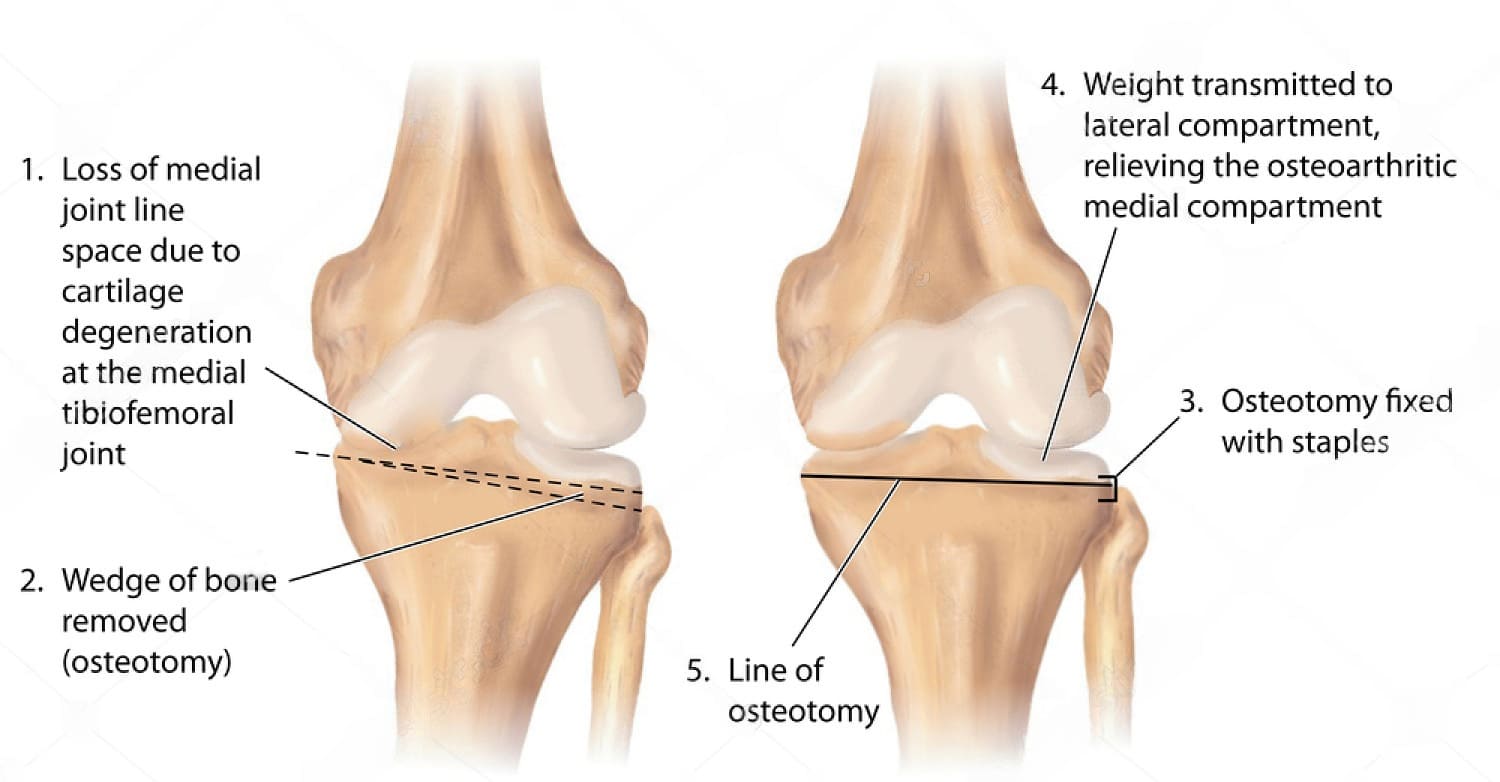
Osteotomy is a surgical procedure that involves cutting and reshaping bones to correct deformities, relieve pain, and improve function. It is commonly performed on weight-bearing joints such as the knee and hip but can be done on other bones as well.
Indications for Osteotomy
Osteotomy is recommended for various conditions, including:
- Osteoarthritis: Particularly in younger, active patients where joint preservation is preferred over joint replacement.
- Bone Deformities: Congenital or acquired deformities that impair function or cause pain.
- Fracture Malunion: When bones heal improperly after a fracture.
- Developmental Conditions: Such as hip dysplasia or Blount’s disease.
Common Types of Osteotomy
High Tibial Osteotomy (HTO):
- Used to treat knee osteoarthritis, particularly in patients with a varus (bow-legged) deformity.
- Involves cutting the tibia (shinbone) and realigning it to redistribute weight across the knee joint.
Distal Femoral Osteotomy (DFO):
- Addresses valgus (knock-knee) deformities.
- Involves cutting and realigning the distal femur (thighbone).
Pelvic Osteotomy:
- Used to treat hip dysplasia, particularly in young patients.
- Examples include the Ganz periacetabular osteotomy, which reorients the hip socket.
Spinal Osteotomy:
- Used to correct spinal deformities such as scoliosis or kyphosis.
- Types include Smith-Petersen osteotomy and pedicle subtraction osteotomy.
The Surgical Procedure
Preoperative Planning:
- Detailed imaging studies (X-rays, CT scans, MRIs) to plan the precise location and extent of the osteotomy.
- Preoperative discussions about the risks, benefits, and expected outcomes.
Anesthesia:
- General or regional anesthesia is administered.
Incision and Exposure:
- The surgeon makes an incision over the affected area and exposes the bone.
Bone Cutting and Realignment:
- The bone is cut using specialized surgical instruments.
- The cut bone segments are realigned to the desired position.
Stabilization:
- The realigned bone is stabilized using locking plates, screws, or other external fixator
- Sometimes, bone grafts are used to aid healing.
Closure:
- The surgical site is closed with sutures or staples, and a sterile dressing is applied.
Postoperative Care and Rehabilitation
Hospital Stay:
- Patients may stay in the hospital for a few days, depending on the complexity of the surgery and their overall health.
Pain Management:
- Pain is managed with medications, including opioids, NSAIDs, and local anesthetics.
Mobility and Weight-Bearing:
- Initial immobilization with a cast, brace, or splint.
- Gradual weight-bearing and movement as per the surgeon’s advice.
Physical Therapy:
- A critical component of recovery, focusing on restoring range of motion, strength, and function.
- Tailored exercises and activities to enhance recovery.
Follow-Up Visits:
- Regular appointments to monitor healing and adjust the rehabilitation program as needed.
Risks and Complications
- Infection: As with any surgery, there is a risk of infection.
- Nonunion or Malunion: Bones may not heal properly or align as intended.
- Nerve or Blood Vessel Damage: Potential injury to surrounding structures.
- Hardware Problems: Plates or screws may irritate tissues or become loose.
Outcomes and Prognosis
- Pain Relief and Function: Many patients experience significant pain relief and improved function.
- Long-Term Benefits: Properly performed osteotomies can delay or even prevent the need for joint replacement.
- Recovery Time: Full recovery can take several months, and adherence to rehabilitation protocols is crucial for optimal outcomes.
Conclusion
Osteotomy is a valuable surgical technique for correcting bone deformities and treating joint conditions, offering an alternative to joint replacement for many patients. Successful outcomes depend on careful patient selection, precise surgical execution, and diligent postoperative care. Always consult with a qualified orthopedic surgeon to discuss the best treatment options for your specific condition.

You must be logged in to post a comment.