

Fractures of the proximal humerus are among the most common upper-limb injuries, particularly in elderly patients with osteoporosis and individuals who experience high-energy trauma. The management of these fractures has evolved significantly over the years with the introduction of advanced fixation technologies. Among the most successful innovations in modern orthopaedic surgery is the PHILOS Plate, a specialized implant designed to provide stable fixation for complex proximal humerus fractures.
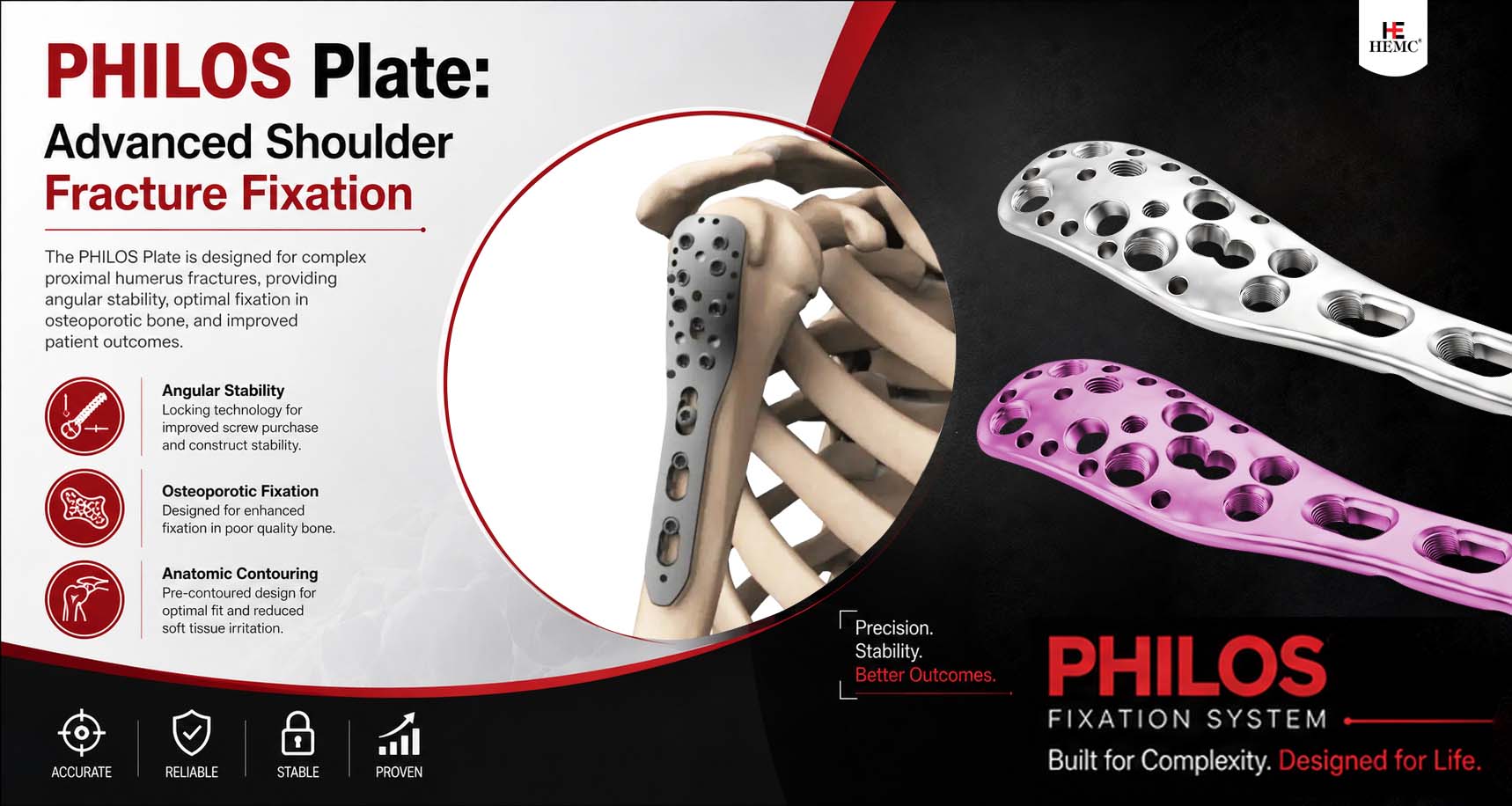
PHILOS, which stands for Proximal Humeral Internal Locking System, is a pre-contoured locking plate specifically developed to address the anatomical and biomechanical challenges associated with fractures of the proximal humerus. By combining the principles of angular stability and minimally invasive fixation, the PHILOS Plate has become a preferred choice among orthopaedic surgeons worldwide.
As the field of orthopaedic implants continues to advance, devices such as locking plates, interlocking nails, spine implants, and large fragment implants play a critical role in restoring patient mobility and improving surgical outcomes. The PHILOS Plate stands out as one of the most effective solutions for shoulder fracture management.
Understanding Proximal Humerus Fractures
The proximal humerus is the upper segment of the arm bone that forms part of the shoulder joint. Fractures in this region commonly occur due to falls, sports injuries, road traffic accidents, and osteoporosis-related trauma.
These fractures can range from simple two-part fractures to highly complex multi-fragmented injuries involving the humeral head, greater tuberosity, lesser tuberosity, and surgical neck. Treating such fractures requires precise anatomical reduction and stable fixation to ensure early mobilization and proper healing.
Traditional fixation methods often faced challenges such as screw loosening, implant failure, and loss of reduction, especially in osteoporotic bone. The introduction of locking plates such as the PHILOS Plate addressed many of these concerns by providing enhanced fixation strength and improved stability.
What is a PHILOS Plate?
The PHILOS Plate is an anatomically contoured locking plate specifically designed for the treatment of proximal humerus fractures. Manufactured from high-grade titanium or stainless steel, it incorporates multiple locking screw options that provide angular stability and secure fixation.
Unlike conventional plates, where stability depends largely on friction between the plate and bone, the PHILOS Plate creates a fixed-angle construct through the locking mechanism between the screws and plate. This design significantly reduces the risk of screw pullout and fixation failure.
The implant is carefully shaped to match the anatomy of the proximal humerus, allowing surgeons to achieve accurate placement while minimizing soft tissue disruption.
Key Features of the PHILOS Plate
Anatomical Design
- The plate is pre-contoured to fit the natural anatomy of the proximal humerus. This minimizes the need for intraoperative bending and ensures optimal positioning.
Locking Screw Technology
- The defining feature of the PHILOS Plate is its locking screw mechanism. The screws lock directly into the plate, creating a stable fixed-angle construct that enhances fixation strength.
Multiple Screw Trajectories
- The proximal portion of the plate contains multiple screw holes arranged in various directions. This allows surgeons to achieve excellent fixation in the humeral head and support multiple fracture fragments.
Angular Stability
- Angular stability is particularly important in osteoporotic bone where traditional fixation methods may fail. The locking mechanism provides superior stability and reduces the likelihood of implant loosening.
Minimally Invasive Application
- The PHILOS Plate can often be inserted using minimally invasive surgical techniques, preserving blood supply and promoting faster healing.
Clinical Indications
- The PHILOS Plate is commonly indicated for:
- Two-part proximal humerus fractures
- Three-part proximal humerus fractures
- Four-part proximal humerus fractures
- Osteoporotic fractures
- Fracture dislocations
- Non-unions and malunions
- Revision surgeries
- Complex shoulder trauma cases
Its versatility makes it suitable for a wide range of fracture patterns and patient populations.
Advantages of the PHILOS Plate
Superior Stability
- One of the most significant advantages of the PHILOS Plate is the enhanced stability it provides. The locking screw system creates a rigid construct capable of maintaining fracture reduction even in poor-quality bone.
Improved Fixation in Osteoporotic Bone
- Elderly patients often present with compromised bone quality. Conventional plating systems may not provide adequate purchase in such cases. The PHILOS Plate’s locking mechanism significantly improves fixation strength and reduces failure rates.
Early Mobilization
- Stable fixation allows patients to begin rehabilitation exercises earlier, reducing stiffness and improving functional recovery.
Reduced Risk of Implant Failure
- The fixed-angle design minimizes screw loosening, plate displacement, and secondary fracture collapse.
Better Anatomical Reconstruction
- The plate’s contour and screw configuration facilitate accurate restoration of anatomy, which is critical for shoulder function.
Surgical Technique Overview
The surgical procedure typically begins with patient positioning in the beach-chair position. A deltopectoral approach is commonly used to access the fracture site.
The fracture fragments are carefully reduced and temporarily stabilized using Kirschner wires. The PHILOS Plate is then positioned lateral to the bicipital groove and fixed using a combination of cortical and locking screws.
Fluoroscopic imaging is used throughout the procedure to verify reduction quality, plate positioning, and screw placement.
Once fixation is complete, the stability of the construct is assessed, and the wound is closed in layers.
Rehabilitation and Recovery
Postoperative rehabilitation plays a crucial role in achieving successful outcomes.
Phase 1: Early Recovery
- During the initial weeks, patients typically wear a sling while performing passive range-of-motion exercises.
Phase 2: Intermediate Recovery
- As healing progresses, active-assisted exercises are introduced to restore shoulder mobility.
Phase 3: Strengthening Phase
- Strengthening exercises are gradually added to improve muscle function and joint stability.
Most patients experience significant improvement within several months, although complete recovery may take up to one year depending on fracture complexity and patient factors.
Comparison with Other Orthopaedic Implants
Modern fracture management involves various categories of orthopaedic implants, each designed for specific anatomical regions and injury patterns.
PHILOS Plate vs Locking Plates
- The PHILOS Plate is a specialized form of locking plate designed specifically for proximal humerus fractures. While general locking plates are used throughout the body, the PHILOS system incorporates shoulder-specific anatomical features and screw trajectories.
PHILOS Plate vs Interlocking Nails
- Interlocking nails are commonly used for fractures of long bones such as the femur, tibia, and humerus. While interlocking nails provide excellent load-sharing characteristics, they may not offer the same level of fragment-specific fixation required for complex proximal humerus fractures.
The PHILOS Plate allows surgeons to stabilize multiple fracture fragments with greater precision, making it a preferred option for many shoulder injuries.
PHILOS Plate and Large Fragment Implants
- Large fragment implants are frequently utilized for major fractures involving larger bones and substantial load-bearing requirements. Although both systems provide stable fixation, the PHILOS Plate is specifically engineered for the unique anatomy and biomechanics of the shoulder region.
Relationship to Spine Implants
- While spine implants are designed to stabilize the vertebral column and address spinal disorders, both spine implants and PHILOS Plates share a common objective: achieving stable fixation while promoting bone healing and functional recovery.
Advancements in implant design, biomaterials, and locking technology have benefited both fields significantly
Materials and Manufacturing
Modern PHILOS Plates are typically manufactured from titanium alloys or medical-grade stainless steel.
Titanium offers several advantages, including:
- High strength-to-weight ratio
- Excellent corrosion resistance
- Superior biocompatibility
- Reduced imaging artifacts
- Enhanced patient comfort
Advanced manufacturing technologies ensure precise dimensions, consistent quality, and reliable mechanical performance.
Potential Complications
Although the PHILOS Plate has demonstrated excellent clinical outcomes, complications can occasionally occur.
Possible complications include:
- Infection
- Screw penetration into the joint
- Loss of reduction
- Implant failure
- Avascular necrosis
- Non-union
- Shoulder stiffness
Proper surgical technique, patient selection, and postoperative rehabilitation significantly reduce these risks.
Future Developments in Shoulder Fixation Technology
The future of orthopaedic implants continues to evolve rapidly. Emerging technologies include:
- Patient-specific implant designs
- Advanced titanium alloys
- 3D-printed implants
- Smart implants with sensor technology
- Improved locking mechanisms
- Bioactive surface coatings
These innovations aim to improve fixation strength, accelerate healing, and enhance patient outcomes.
As technologies used in locking plates, interlocking nails, spine implants, and large fragment implants continue to advance, future generations of PHILOS Plates are expected to offer even greater performance and surgical versatility.
Conclusion
The PHILOS Plate represents a major advancement in the treatment of proximal humerus fractures. Its anatomical design, locking screw technology, angular stability, and ability to provide reliable fixation in osteoporotic bone have made it a cornerstone of modern shoulder fracture management.
By enabling stable fixation, early mobilization, and improved functional outcomes, the PHILOS Plate has transformed the way surgeons approach complex proximal humerus injuries. Alongside other essential orthopaedic implants such as locking plates, interlocking nails, spine implants, and large fragment implants, it continues to play a vital role in advancing patient care and restoring mobility.
As orthopaedic technology progresses, the PHILOS Plate will remain an important component of contemporary fracture fixation strategies, helping patients achieve faster recovery and better long-term results.