

Fractures of the humerus are among the most common upper limb injuries treated by orthopedic surgeons. These fractures can occur due to high-energy trauma, sports injuries, road traffic accidents, or low-energy falls in elderly patients with osteoporosis. Depending on the fracture location and severity, surgical fixation may be required to restore the anatomy, maintain stability, and enable early rehabilitation.
Among the various fixation techniques available today, the Humerus Nailing System has become one of the preferred solutions for managing humeral shaft fractures. Intramedullary nailing offers a minimally invasive approach with excellent biomechanical stability while preserving the surrounding soft tissues and blood supply. Compared to conventional plating techniques, humerus nails often result in reduced operative time, less blood loss, and faster recovery.
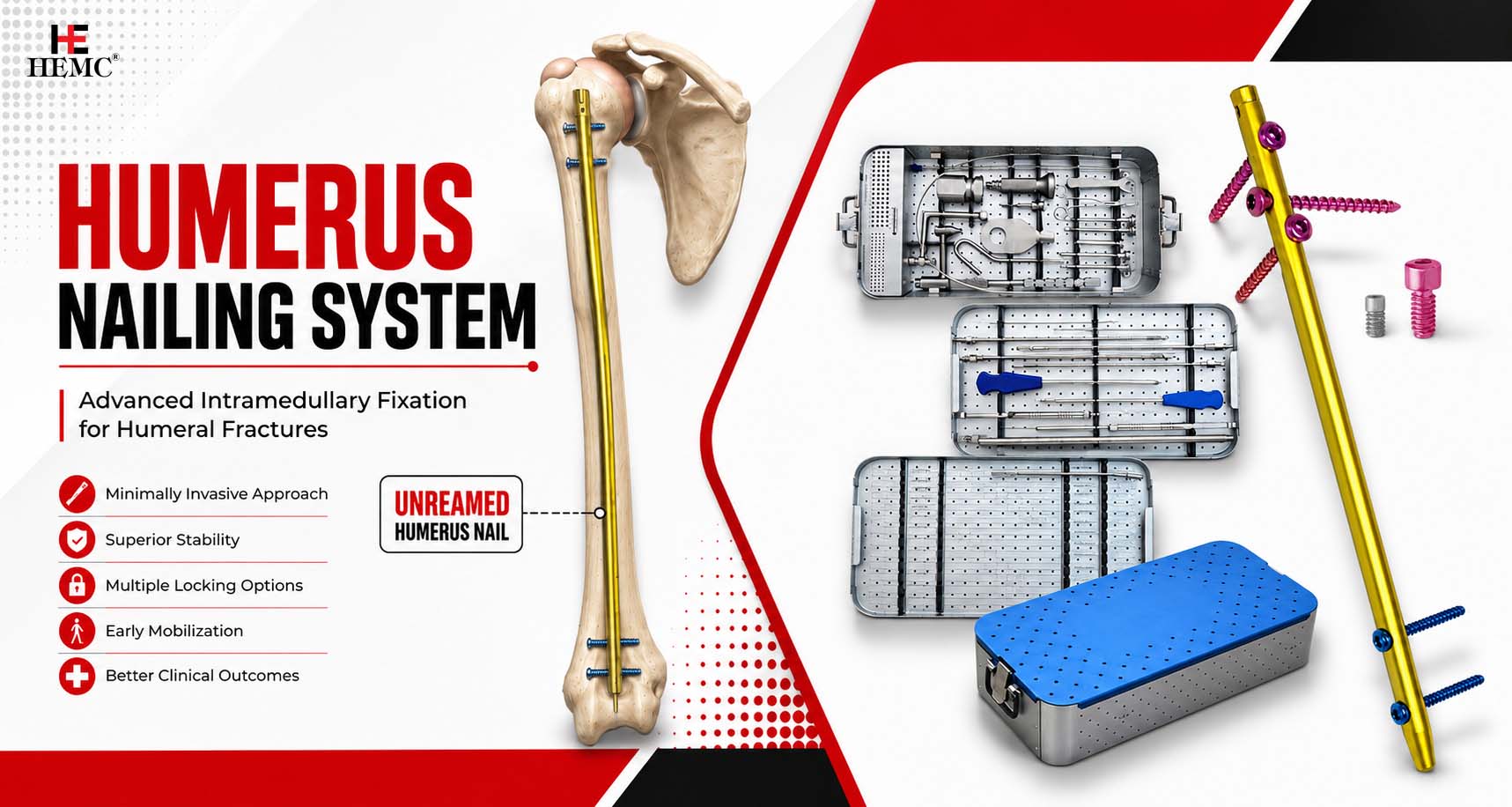
A complete Humerus Nailing System consists of several precision-engineered components, including the Unreamed Humerus Nail, End Cap Humerus Nail, End Cap Humerus Nail Cannulated, and a dedicated Instrument Set for Humerus Nail. Together, these implants and instruments provide orthopedic surgeons with a reliable solution for treating simple and complex humeral fractures.
What is a Humerus Nailing System?
A Humerus Nailing System is an intramedullary fixation device specifically designed for stabilizing fractures of the humeral shaft. The implant is inserted into the medullary canal of the humerus, allowing fixation from within the bone rather than using plates attached to the outer surface.
The intramedullary location places the implant closer to the mechanical axis of the humerus, reducing bending forces and providing excellent load-sharing characteristics. This promotes fracture healing while allowing patients to begin controlled shoulder and elbow movement early in the recovery process.
Modern humerus nails are available in multiple lengths and diameters to accommodate different patient anatomies and fracture patterns.
Components of the Humerus Nailing System
A complete Humerus Nailing System includes several specialized implants and instruments designed to work together for precise fracture fixation.
Humerus Nail Cannulated
The Humerus Nail Cannulated is an advanced intramedullary implant designed for the surgical fixation of humeral shaft fractures. Its cannulated design allows insertion over a guide wire, enabling accurate placement while supporting minimally invasive surgical techniques. Manufactured from high-quality titanium alloy or surgical-grade stainless steel, the implant provides excellent biomechanical stability, promotes fracture healing, and facilitates early mobilization. The Humerus Nail Cannulated is available in various lengths and diameters to accommodate different patient anatomies and fracture patterns, making it a reliable choice for modern orthopedic trauma surgery.
Key Features include:
- Cannulated design for precise guide wire-assisted insertion.
- Minimally invasive implantation with reduced soft tissue damage.
- Manufactured from premium titanium alloy or 316L stainless steel.
- Multiple proximal and distal locking options for enhanced stability.
- Excellent rotational and axial fixation.
- Available in various lengths and diameters.
- Supports early patient mobilization and rehabilitation.
- High corrosion resistance and long-term durability.
- Compatible with dedicated Humerus Nail Instrument Sets.
- Designed for effective treatment of humeral shaft fractures.
Unreamed Humerus Nail
The Unreamed Humerus Nail is the primary implant used in the fixation system. It is designed for insertion without extensive reaming of the medullary canal, helping preserve the bone’s internal blood supply.
Key features include:
- Anatomically contoured design
- Titanium or stainless steel construction
- Multiple proximal and distal locking options
- Excellent rotational stability
- Minimal soft tissue disruption
- Reduced operative time
- Preservation of endosteal blood circulation
The Unreamed Humerus Nail is particularly beneficial for patients with narrow medullary canals or compromised bone quality, where preserving the biological environment is essential for healing.
End Cap Humerus Nail
The End Cap Humerus Nail is fitted to the proximal end of the intramedullary nail after implantation.
Its functions include:
- Preventing tissue ingrowth
- Protecting the proximal nail opening
- Increasing construct stability
- Assisting future implant removal
- Maintaining implant positioning
Although relatively small, the End Cap Humerus Nail contributes significantly to the long-term performance of the fixation construct.
End Cap Humerus Nail Cannulated
The End Cap Humerus Nail Cannulated is a specialized version of the standard end cap featuring a central cannulation.
Advantages include:
- Easy insertion over guide wires
- Improved surgical precision
- Simplified implant positioning
- Enhanced compatibility with minimally invasive techniques
- Reliable locking of the intramedullary nail
The cannulated design allows surgeons to perform implantation with greater accuracy while reducing procedural complexity.
Instrument Set for Humerus Nail
A dedicated Instrument Set for Humerus Nail is essential for accurate and efficient implantation.
A standard instrument set typically includes:
- Guide wires
- Bone awls
- Nail inserters
- Drill sleeves
- Depth gauges
- Locking screw guides
- Screwdrivers
- Targeting devices
- Extraction instruments
- Alignment handles
- Reduction tools
A high-quality Instrument Set for Humerus Nail ensures accurate implant placement, minimizes surgical time, and improves overall operating room efficiency.
Indications for Humerus Nailing
The Humerus Nailing System is commonly indicated for treating a variety of humeral fractures, including:
- Humeral shaft fractures
- Segmental fractures
- Comminuted fractures
- Pathological fractures
- Delayed union
- Nonunion cases
- Osteoporotic fractures
- Polytrauma patients
- Revision fixation procedures
Patient age, fracture pattern, bone quality, and overall health determine whether intramedullary nailing is the most suitable treatment option.
Surgical Technique
The Humerus Nailing procedure is performed under fluoroscopic guidance using minimally invasive surgical techniques.
Step 1: Patient Positioning
- The patient is positioned in either the beach-chair or supine position depending on surgeon preference.
Step 2: Fracture Reduction
- Closed or minimally invasive reduction restores proper alignment before nail insertion.
Step 3: Entry Point
- A small incision is made near the proximal humerus to access the medullary canal.
Step 4: Nail Insertion
- The Unreamed Humerus Nail is inserted into the humeral canal using dedicated insertion instruments.
Step 5: Locking Screw Placement
- Proximal and distal locking screws are inserted through targeting devices to prevent rotation and shortening.
Step 6: End Cap Placement
- The surgeon installs either the End Cap Humerus Nail or the End Cap Humerus Nail Cannulated depending on the selected implant configuration.
Step 7: Final Assessment
- Fluoroscopic imaging confirms satisfactory fracture reduction, implant positioning, and locking screw placement before wound closure.
Advantages of the Humerus Nailing System
The Humerus Nailing System offers several important clinical and surgical advantages.
Minimally Invasive Surgery
- Smaller incisions reduce muscle injury, preserve soft tissues, and promote faster healing.
Biological Fixation
- Because the fracture site is minimally exposed, the surrounding blood supply remains largely intact, enhancing bone healing.
Excellent Biomechanical Stability
- Intramedullary fixation aligns closely with the natural mechanical axis of the humerus, reducing stress on the implant.
Reduced Blood Loss
- Compared with plate fixation, humeral nailing generally results in less intraoperative blood loss.
Early Mobilization
- Stable fixation enables patients to begin shoulder and elbow exercises earlier, reducing stiffness and improving functional recovery.
Lower Infection Risk
- Smaller surgical exposure decreases the likelihood of postoperative wound complications.
Faster Recovery
- Many patients experience quicker rehabilitation and an earlier return to daily activities compared with traditional fixation methods.
Benefits for Orthopedic Surgeons
The Humerus Nailing System is designed to improve surgical efficiency and reproducibility.
Key benefits include:
- Accurate targeting systems
- Simplified surgical workflow
- Multiple nail sizes
- Reliable locking mechanisms
- Shorter operating time
- Reduced fluoroscopy exposure
- Easy instrumentation
- Consistent clinical outcomes
The comprehensive Instrument Set for Humerus Nail further enhances precision during every stage of the procedure.
Materials Used
Modern humerus nails are manufactured from premium orthopedic-grade materials, including:
- Titanium Alloy
- 316L Stainless Steel
Titanium implants offer several advantages:
- Excellent biocompatibility
- Superior corrosion resistance
- High fatigue strength
- Lightweight construction
- MRI compatibility
- Long-term durability
These material properties contribute to reliable orthopaedic implant performance and patient safety.
Postoperative Care
Successful fracture healing depends not only on surgical fixation but also on structured rehabilitation.
Typical postoperative management includes:
- Pain control
- Early passive shoulder exercises
- Gradual active range-of-motion exercises
- Muscle strengthening
- Regular radiographic follow-up
- Physiotherapy
- Progressive return to normal activities
Healing time varies depending on fracture complexity, patient age, and overall health but generally ranges from several weeks to a few months.
Choosing the Right Humerus Nailing System
When selecting a Humerus Nailing System, hospitals and surgeons should evaluate several important factors:
- High-quality implant manufacturing
- Availability of multiple nail lengths and diameters
- Precision-engineered Unreamed Humerus Nail
- Reliable End Cap Humerus Nail
- Compatible End Cap Humerus Nail Cannulated
- Comprehensive Instrument Set for Humerus Nail
- Biocompatible implant materials
- Sterilization compatibility
- Regulatory certifications
- Strong manufacturer support
Choosing a well-designed implant system contributes significantly to improved patient outcomes and long-term implant reliability.
Why Hospitals Prefer Modern Humerus Nails
Healthcare institutions increasingly prefer intramedullary humerus fixation because it offers predictable surgical outcomes while reducing hospitalization time.
Modern Humerus Nailing Systems help surgeons achieve:
- Better fracture alignment
- Stable fixation
- Reduced soft tissue damage
- Early rehabilitation
- Lower complication rates
- Improved patient satisfaction
- Faster return to functional activities
These advantages make humerus nails an essential part of contemporary orthopedic trauma care.
Conclusion
The Humerus Nailing System represents a highly effective solution for the treatment of humeral shaft fractures. By combining minimally invasive surgical techniques with strong biomechanical fixation, it enables faster healing, earlier mobilization, and improved patient outcomes.
Core components such as the Unreamed Humerus Nail, End Cap Humerus Nail, End Cap Humerus Nail Cannulated, and the dedicated Instrument Set for Humerus Nail work together to provide precise implantation, secure fixation, and long-term stability.
As orthopedic technology continues to advance, Humerus Nailing Systems remain a trusted choice for trauma surgeons seeking reliable, efficient, and biologically friendly fracture fixation. Whether treating simple shaft fractures or more complex injury patterns, these systems continue to play a vital role in modern orthopedic practice, delivering excellent clinical results for both surgeons and patients.