


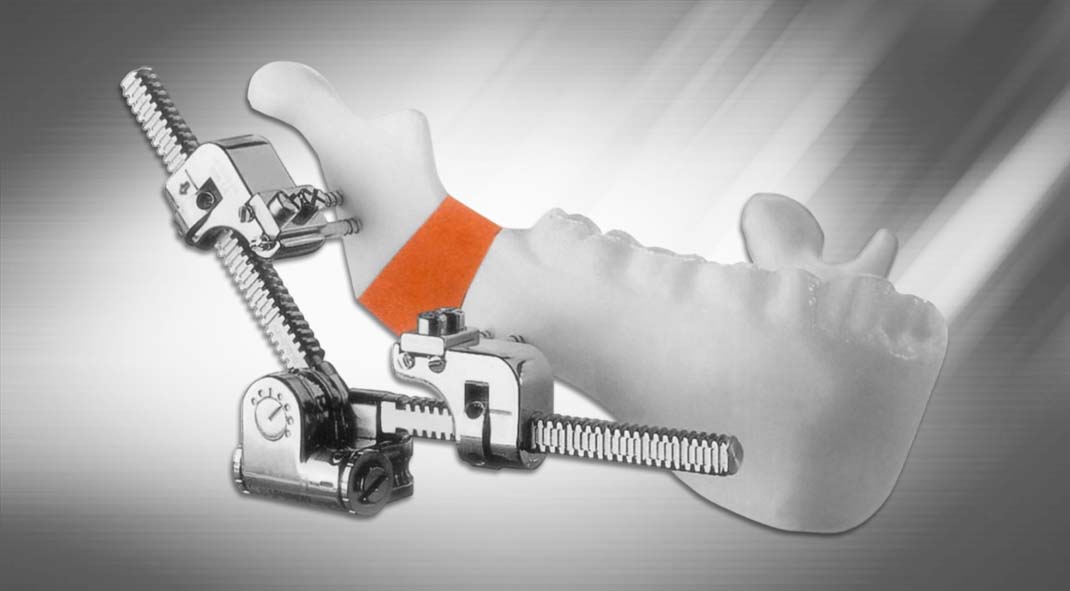
A multi-guided mandibular distractor in orthopedics—specifically in craniofacial or maxillofacial surgery—is a specialized device used in distraction osteogenesis to lengthen or reshape the mandible (lower jaw). The term “multi-guided” refers to the device’s ability to control multiple vectors or directions of movement, allowing for complex, three-dimensional corrections of jaw deformities.
Breakdown of the Term:
Mandibular: Refers to the mandible, or lower jaw.
Distractor: A device used to gradually separate bone segments after a surgical cut (osteotomy), allowing new bone to form in the gap (distraction osteogenesis).
Multi-guided: The distractor can guide bone movement along multiple planes (e.g., vertical, horizontal, angular), enabling precise control over the bone’s trajectory and final shape.
Purpose and Uses:
Used in orthognathic surgery or craniofacial reconstruction to correct:
- Mandibular hypoplasia (underdeveloped jaw)
- Asymmetries
- Congenital defects (e.g., Pierre Robin sequence, hemifacial microsomia)
- Post-traumatic deformities
Key Features:
- Adjustable arms or rods to control the direction and extent of movement.
- External or internal fixation depending on the surgical approach.
- Allows for customized bone growth patterns.
- Facilitates 3D mandibular reconstruction when single-vector distraction is insufficient.
Multi-Guided Mandibular Distractor – How Does It Works
Preoperative Planning
- 3D imaging (CT scans or cone-beam CT) is used to assess the deformity.
- Virtual surgical planning (VSP) may be employed to map out the exact bone movements in multiple vectors (forward, downward, sideways, or rotational).
- A custom distractor is selected or designed based on the patient’s anatomy and surgical goal
Surgical Procedure (Osteotomy and Device Placement)
Osteotomy (Bone Cut)
- A precise cut is made in the mandible at the planned location (usually in the body, angle, or ramus of the mandible).
- This separates the bone into two segments: a stationary part and a mobilized part.
Device Fixation
- The multi-guided distractor is fixed to both bone segments using screws or plates.
- It consists of adjustable arms or rods that allow motion in more than one direction (e.g., forward + downward + rotational).
- The orientation and initial settings are confirmed intraoperatively.
Latency Period (3–7 Days)
- After surgery, there’s a waiting period to allow initial healing of the bone and surrounding soft tissues.
- No activation is done during this time.
Distraction Phase (Active Bone Lengthening)
- The distractor is gradually activated, usually 0.5–1 mm per day, in multiple controlled directions.
- Activation is often done manually by the patient or caregiver using a small tool or screw mechanism.
- Over 1–3 weeks, the bone segments are slowly pulled apart, and new bone forms in the gap (distraction osteogenesis).
- Because the device is multi-guided, the surgeon can adjust the vector of movement at any time during this phase.
Consolidation Phase (Bone Hardening)
- Once the desired length and shape are achieved, the distraction is stopped.
- The distractor remains in place for 6–12 weeks while the newly formed bone hardens and matures.
- The patient is monitored regularly with imaging to confirm bone formation.
Device Removal
- After consolidation, the distractor is surgically removed under local or general anesthesia.
- By this time, the new bone has fully integrated, and the jaw remains in its new position.
Postoperative Follow-Up
Follow-up may include:
- Imaging (X-rays or CT scans)
- Functional assessments (chewing, speaking, breathing)
- Orthodontic treatment if needed
- Scar care or cosmetic refinements if external devices were used
Advantages of Multi-Guided Distractors:
Here are the detailed benefits of a multi-guided mandibular distractor in orthopaedic and maxillofacial surgery:
Precise 3D Correction
Multi-vector control allows the mandible to be moved in several directions (e.g., forward, downward, outward, and rotated).
Enables correction of complex deformities that involve asymmetry or multi-dimensional underdevelopment of the jaw.
Improved Aesthetic Outcomes
Because the bone can be guided precisely, surgeons can achieve better facial symmetry and proportion.
This is especially important in cases of congenital deformities (e.g., hemifacial microsomia) or trauma reconstruction.
Enhanced Functional Outcomes
By lengthening and repositioning the jaw, it can improve:
- Airway patency (e.g., for sleep apnea or breathing issues in children)
- Oral function (chewing, speaking)
- Dental occlusion (bite alignment)
Avoids the Need for Bone Grafts
- Distraction osteogenesis with a multi-guided device stimulates natural bone growth.
- Eliminates or reduces the need for donor site grafts, which can cause additional morbidity.
Customizable and Adjustable
- The device can be adjusted during the distraction phase, allowing surgeons to modify the direction or rate of movement in real time.
- This is especially useful in growing children, where bone adaptation is critical.
Promotes Soft Tissue Adaptation
- Gradual distraction allows soft tissues (skin, muscle, nerves, and blood vessels) to stretch and grow with the bone.
- Reduces the risk of complications compared to acute bone repositioning surgeries.
Reduces Risk of Relapse
- The slow, controlled process encourages stable bone regeneration, minimizing the risk of the jaw moving back to its original position (relapse).
Suitable for Severe Cases
- Allows treatment of cases that are not amenable to traditional orthognathic surgery, particularly when jaw deformities are severe, asymmetrical, or involve airway compromise.
Long-Term Stability
- Once the consolidation phase is complete, the new bone is biologically integrated, providing long-term structural and functional stability.

You must be logged in to post a comment.