

The field of maxillofacial surgery has witnessed significant advancements over the past few decades, particularly in the development of specialized fixation systems designed to restore facial anatomy and function. Among these innovations, the Locking Straight Mandibular Reconstruction Plate has emerged as one of the most effective solutions for managing severe mandibular defects, traumatic injuries, tumor resections, and congenital deformities.
As part of the growing family of maxillofacial implants, mandibular reconstruction plates provide surgeons with the strength, stability, and precision required for successful facial reconstruction procedures. These advanced fixation systems are engineered to support bone segments while promoting proper healing and maintaining facial symmetry.
Understanding the Mandible and Its Importance
The mandible, commonly known as the lower jawbone, is the largest and strongest bone in the facial skeleton. It plays a vital role in several functions, including:
- Chewing and mastication
- Speech and communication
- Facial aesthetics
- Breathing support
- Maintaining dental occlusion
When the mandible suffers severe trauma, infection, tumor-related damage, or congenital abnormalities, reconstruction becomes necessary to restore both functionality and appearance. In such situations, a Locking Straight Mandibular Reconstruction Plate serves as a critical component of the surgical treatment plan.
What Is a Locking Straight Mandibular Reconstruction Plate?
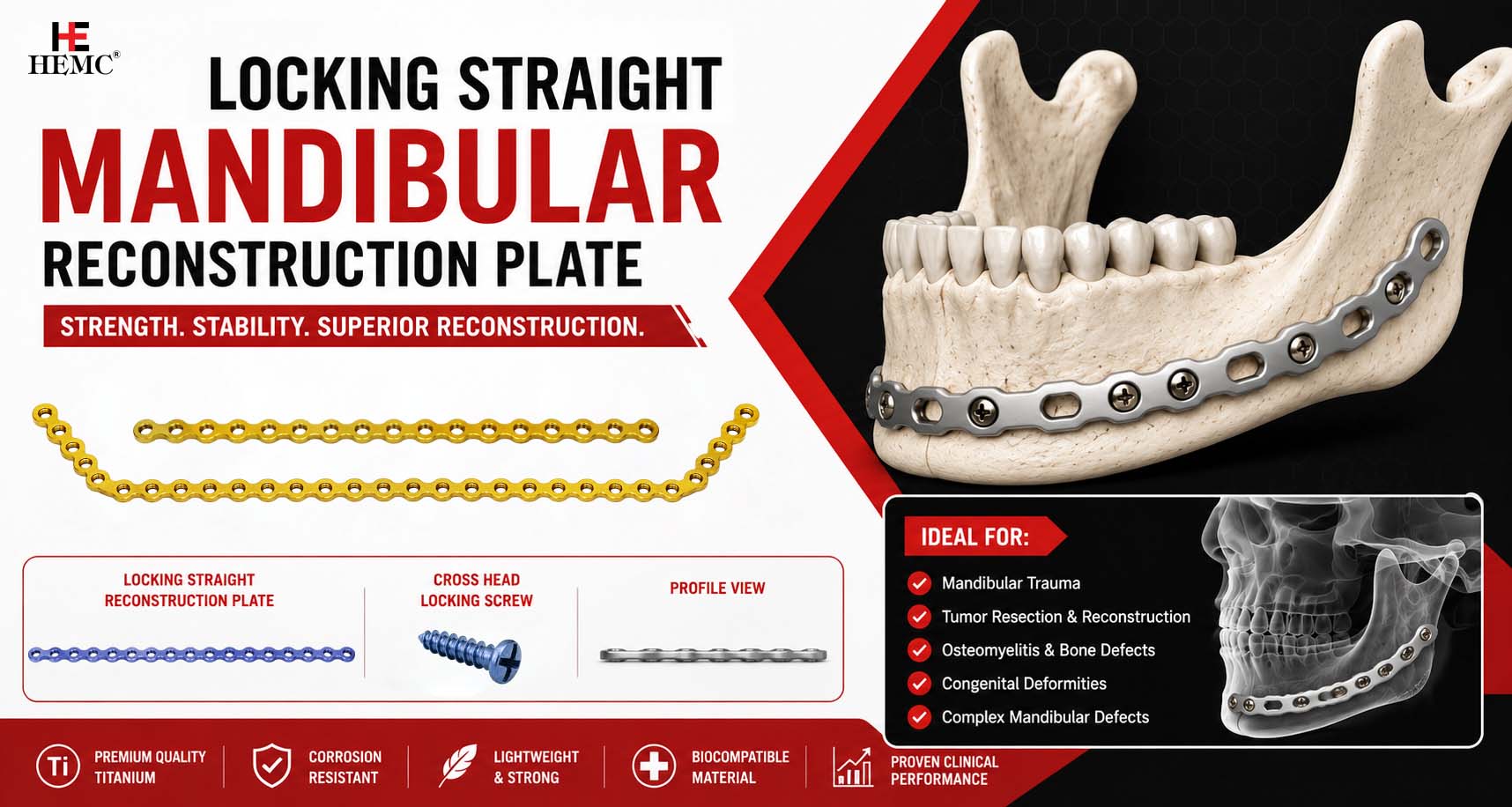
A Locking Straight Mandibular Reconstruction Plate is a heavy-duty fixation device designed to stabilize and reconstruct mandibular defects. Manufactured from high-quality titanium or titanium alloy, these plates are engineered to withstand significant biomechanical forces generated during jaw movement.
Unlike conventional fixation systems, locking reconstruction plates utilize a locking mechanism between the plate and screw, creating a rigid and stable construct. This design minimizes micro-movement at the surgical site and enhances healing outcomes.
These plates are commonly used with cross head locking screws, which securely lock into the plate holes, providing exceptional stability even in compromised bone conditions.
Key Components of the Reconstruction System
Locking Reconstruction Plate
- The primary component is the straight reconstruction plate itself, which bridges mandibular defects and provides structural support.
Cross Head Locking Screws
- Cross head locking screws are specifically designed to engage with threaded plate holes. Their locking mechanism offers several advantages:
- Enhanced fixation strength
- Reduced screw loosening
- Improved load distribution
- Increased resistance to functional forces
Bone Grafts or Flaps
- In many reconstructive procedures, bone grafts or vascularized free flaps are used alongside the reconstruction plate to restore lost bone volume.
Design Features of Locking Straight Mandibular Reconstruction Plates
Modern reconstruction plates incorporate several advanced design characteristics:
High-Strength Titanium Construction
Titanium remains the preferred material due to its:
- Excellent biocompatibility
- Corrosion resistance
- High strength-to-weight ratio
- Compatibility with medical imaging
Anatomical Adaptability
- Although straight in design, these plates can be contoured intraoperatively to match the patient’s unique mandibular anatomy.
Multiple Screw Hole Configurations
- Strategically placed holes allow surgeons to achieve optimal fixation using cross head locking screws.
Low-Profile Design
- Modern systems feature thinner profiles to minimize soft tissue irritation while maintaining strength.
Locking Technology
- The threaded interface between screws and plate creates a fixed-angle construct that enhances stability.
Clinical Applications
- Locking straight mandibular reconstruction plates are widely used across various maxillofacial procedures.
Mandibular Trauma
- High-impact injuries from road accidents, sports injuries, or industrial accidents can result in complex mandibular fractures.
In these situations, reconstruction plates provide:
- Immediate stabilization
- Accurate bone alignment
- Restoration of jaw function
- Reduced risk of malunion
Tumor Resection Reconstruction
Patients undergoing mandibular tumor removal often require extensive reconstruction.
The reconstruction plate serves as a scaffold that:
- Maintains mandibular continuity
- Supports bone grafts
- Restores facial contour
- Enables future rehabilitation
Osteomyelitis and Infection Management
- Severe infections can lead to bone loss and structural instability. Reconstruction plates help maintain mandibular integrity during the healing process.
Congenital Deformities
- Certain congenital conditions require corrective jaw reconstruction, where locking plates provide reliable support.
Advantages of Locking Straight Mandibular Reconstruction Plates
Superior Stability
- The locking mechanism prevents screw loosening and provides a highly stable fixation construct.
Reduced Plate Movement
- Because the screw locks directly into the plate, there is minimal movement between components.
Better Healing Environment
- Stable fixation encourages proper bone healing and reduces complications.
Preservation of Blood Supply
- Unlike conventional compression plating systems, locking plates require less compression against the bone surface, helping preserve periosteal blood circulation.
Enhanced Load Distribution
- Functional forces are distributed across the entire plate-screw construct, reducing stress concentration.
Improved Long-Term Outcomes
Patients often experience:
- Faster recovery
- Better function
- Improved aesthetics
- Lower complication rates
Role of CAD Plates in Modern Mandibular Reconstruction
Technological advancements have introduced CAD Plates (Computer-Aided Design Plates) into reconstructive surgery.
These patient-specific plates are designed using:
- CT imaging
- 3D surgical planning
- Digital modeling software
Benefits of CAD Plates include:
- Precise anatomical fit
- Reduced operating time
- Improved surgical accuracy
- Enhanced aesthetic outcomes
While standard locking straight reconstruction plates remain widely used, CAD-based solutions are increasingly becoming the preferred option for highly complex reconstructions.
Relationship with Other Maxillofacial Implants
The Locking Straight Mandibular Reconstruction Plate is part of a broader family of maxillofacial implants used in facial reconstruction and trauma management.
Chin Plates
Chin plates are commonly utilized for:
- Genioplasty procedures
- Chin fracture fixation
- Facial contouring surgeries
Although smaller than mandibular reconstruction plates, chin plates operate on similar fixation principles.
Midface Fixation Plates
Used for fractures involving:
- Maxilla
- Zygomatic bone
- Orbital region
Craniofacial Fixation Systems
Designed to stabilize complex facial and cranial fractures.
Together, these maxillofacial implants form a comprehensive system for restoring facial structure and function.
Comparison with Conventional Non-Locking Plates
| Feature | Locking Reconstruction Plate | Conventional Plate |
| Stability | Excellent | Moderate |
| Screw Loosening Risk | Very Low | Higher |
| Fixed-Angle Support | Yes | No |
| Load Distribution | Superior | Limited |
| Bone Compression Requirement | Minimal | Significant |
| Long-Term Reliability | Excellent | Moderate |
The superior mechanical characteristics of locking systems have made them the preferred choice in many complex reconstructive procedures.
Influence of Orthopaedic Implant Technology
Many innovations seen in mandibular reconstruction systems originate from developments in orthopaedic implants.
The orthopaedic industry has pioneered advancements in:
- Locking plate technology
- Titanium metallurgy
- Biomechanical testing
- Fixed-angle fixation systems
These innovations have been successfully adapted to maxillofacial surgery, resulting in stronger and more reliable reconstruction solutions.
Today, principles commonly used in orthopaedic implants are routinely incorporated into modern mandibular fixation systems.
Surgical Procedure Overview
Preoperative Planning
The surgeon evaluates:
- Defect size
- Bone quality
- Occlusion
- Soft tissue condition
Advanced imaging techniques assist in planning optimal plate placement.
Plate Selection and Contouring
The reconstruction plate is selected according to:
- Defect length
- Anatomical requirements
- Surgical objectives
The plate may be manually contoured or replaced by custom CAD Plates.
Screw Fixation
- Cross head locking screws are inserted into the plate and underlying bone.
- The locking interface creates a stable construct capable of withstanding functional loads.
Bone Grafting
- When necessary, graft material is placed to restore mandibular continuity.
Postoperative Monitoring
Patients are monitored for:
- Bone healing
- Infection
- Occlusion stability
- Functional recovery
Future Trends in Mandibular Reconstruction
The future of maxillofacial reconstruction continues to evolve through emerging technologies.
Patient-Specific CAD Plates
- Customized solutions are expected to become increasingly common.
3D Printing
Advanced additive manufacturing enables:
- Customized implants
- Surgical guides
- Anatomical models
Bioactive Implant Surfaces
- Researchers are developing implant coatings that may promote faster bone integration.
Artificial Intelligence-Assisted Planning
- AI-powered surgical planning systems may further improve precision and treatment outcomes.
Advanced Titanium Alloys
- Next-generation materials could provide greater strength while reducing implant weight.
Conclusion
The Locking Straight Mandibular Reconstruction Plate has revolutionized the management of complex mandibular defects and facial trauma. By combining high-strength titanium construction, advanced locking technology, and compatibility with cross head locking screws, these systems provide exceptional stability and long-term clinical success.
As one of the most important maxillofacial implants available today, reconstruction plates play a vital role in restoring both function and aesthetics for patients with severe mandibular injuries or defects. The integration of technologies such as CAD Plates, along with innovations derived from modern orthopaedic implants, continues to elevate the standards of maxillofacial surgery.
When used alongside complementary fixation systems such as locking plates, chin plates, and other specialized maxillofacial implants, locking straight mandibular reconstruction plates offer surgeons a reliable and highly effective solution for achieving successful reconstructive outcomes and improving patients’ quality of life.